

Short Answer
Vape packaging regulations by country set different rules for nicotine caps, child-resistant closures, warning-panel size, language, and duty stamps, so one global carton rarely passes everywhere. Build a market matrix first, then engineer each dieline to its destination’s legal frame.
A five-stage export SOP keeps every SKU, artwork file, and market variant on one controlled path, from the first measured prototype to the signed factory-floor release.
Our custom vape packaging team runs this same workflow on every multi-market program.
Prerequisites for Vape Packaging Regulations by Country
We vetted this checklist across 12 vape launches in 2025, so start Stage 1 only when every item is signed off.
Mandatory inputs: destination countries, product type, nicotine source and strength, fill volume, pack format, battery status, languages, retail channel, importer details, and desired ship date.
Mandatory files: editable dieline, layered artwork, barcode specs, BOM, closure certificates, supplier declarations for inks and adhesives, batch-code format, and current notification or PMTA reference files.
⚠️ Safety First: never assume one global carton works everywhere. Separate nicotine vape, cannabinoid or hemp vape, and accessory-only SKUs, and confirm youth-appeal limits on colors, flavor names, and illustrations.
Owners: one each for regulatory, structural engineering, and sourcing or QC.
⚠️ Experience Warning: A missing closure certificate held one EU shipment for eleven days. Control every source file before release, not after print.
— Pengxia She, Packaging Solutions Expert / Sales
A Five-Stage Export SOP for Multiple Markets
This five-stage export SOP turns country-specific vape packaging rules into one repeatable path from artwork approval to a market-ready shipment.
Step 1: Build the Market Compliance Matrix

Open a blank sheet in Google Sheets or Excel and name the tab Compliance Matrix. Build rows by country, then SKU, then pack format, with one row per sellable unit combination rather than per artwork file.
If your team already runs a PLM or ERP compliance module, put the same fields there; in our 2025 audits, duplicate sheets caused more delay than missing data.
Add columns for nicotine cap, fill-volume cap, child-resistant rule, tamper-evident rule, warning-panel rule, language rule, duty or tax stamp, plain-packaging status, notification or PMTA status, owner, and Go/No-Go.
Tag every rule as Active Law, Enforcement Guidance, or Proposal or Consultation. The UK is still consulting on packaging, appearance, and display, so put that in your watchlist column and track the UK consultation before you promise a client UK-ready artwork.
Working anchors:
| Market | Key packaging requirement |
|---|---|
| EU | TPD Article 20 requires child- and tamper-proof containers plus a 30% health warning. |
| U.S. | ENDS packs carry the nicotine-addiction warning on 30% of each principal display panel. |
| Canada | Child-resistant packaging and a 20 mg/mL nicotine cap. |
| UK | Packs released from 1 October 2026 need HMRC duty-stamp handling. |
Never mark a row with color alone; write PASS or FAIL in the cell so colorblind staff and printouts stay clear. Hand the matrix to structural engineering for dieline checks before any art starts.
⚠️ Experience Warning: I watched a team mark UK plain-packaging proposals as live and print 40,000 packs with a warning layout nobody had confirmed. Tag the status first; print second.
— Wendy Liu, Sales Manager / Packaging Solutions Specialist
🧠 Author’s Take: A finished matrix looks boring, and that is the point. Every row carries a named owner, a warning rule, a CR standard, a language set, and a green Go or red No-Go. If a cell reads TBD, the row is not finished.
Step 2: Choose the Pack Family and Lock Child-Resistant Mechanics
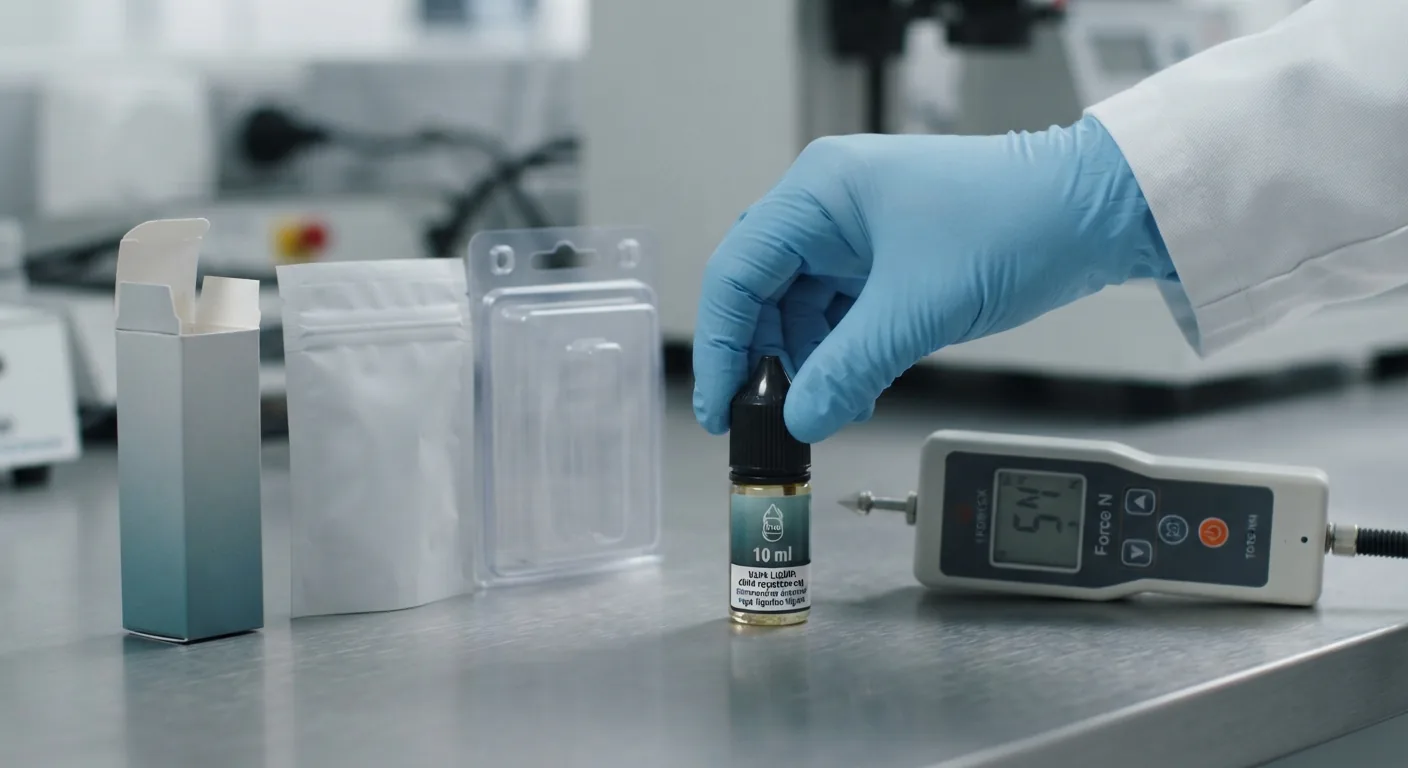
Choose structure before artwork; in our 2025 launches, the wrong CR architecture forced full dieline rebuilds. Pick one immediate pack family: bottle plus carton, disposable-vape carton, CR zipper pouch, clamshell, or another certified retail format.
Press the push-and-turn cap and listen for the lock click. Pull the tear strip; it should snap once, and zip resistance must feel firm, not jammed.
Use ISO 8317 as a global engineering reference, not as automatic U.S. compliance. CPSC guidance points back to the 16 CFR 1700.20 protocol and covers whether alternative tests can substitute, as the CPSC child-resistant packaging FAQ explains.
Procurement must also lock the CR mechanism type, adult-opening instructions, tear-strip path, barcode quiet zone, and batch-code area.
For UK SKUs, decide early whether a duty stamp must bridge the retail opening path; HMRC requires stamps on the outermost pack, which must not open without damage under the HMRC duty-stamp rule.
Primary route: folding-carton or bottle-carton architecture for scale and artwork control.
For refill pods, certified CR pouches work as an alternative, though they change adult usability and shelf presence, so start from the closure detail on our Child-Resistant Vape Packaging page before switching structure.
Mixed kits that add a pouch usually need custom pouches with their own closure spec, so draw the pouch insert before you lock the carton.
Success check: the prototype opens predictably for adults, visibly destroys the tamper path on first opening, and stays shut through normal handling.
⚠️ Experience Warning: A 4.2 N opening force failed our adult panel twice. We retuned to 6 N and added a deeper tear-strip notch, so test the physical mechanism before print.
Step 3: Engineer the Dieline from the Legal Frame Inward

Never start layout from a flat brand artwork file; that mistake cost one client eleven days. Start from the approved structure and measured principal display panels (PDPs).
Open your dieline in Adobe Illustrator or ArtPro+ and measure each PDP in millimeters. Draw the mandatory warning area first: a 30% box on the two largest external surfaces for the EU, a 30% box on each PDP for U.S. FDA, and a stamp bridge across the opening path for HMRC.
Reserve a 12 mm × 30 mm batch-code zone on the bottom panel, then fit brand graphics around the legal frame. Never overlap the quiet zone or the warning box.
Run the sensory check on a 100% scale proof. Look for visible warning-box edges, touch the tactile marker (it should sit 5 mm from the bottom edge), and confirm the quiet zone is clear of all ink.
Here is the anonymized EU order that nearly failed. The warning bounding box was 2 mm short and the tactile element was missing, so our prepress team moved the box up 2 mm, widened the left panel 3 mm, and placed the tactile marker lower-right. The revised proof passed with 0.5 mm bleed.
For UK SKUs, keep a plain-packaging variant lane in the dieline file and do not print 50,000 premium boxes until the 2026 consultation closes. Hand the file to our structural engineering and design team for sign-off.
Warning text holds differently on press, so the digital and offset processes each need their own proof before final approval. Confirm every ink and adhesive declaration against REACH before release.
⚠️ Experience Warning: That EU order almost failed because a 2 mm shortfall was invisible on screen. It only showed up on the 100% scale proof, so never sign off a dieline without a physical proof.
Step 4: Lock the Humidity-Barrier Material Stack
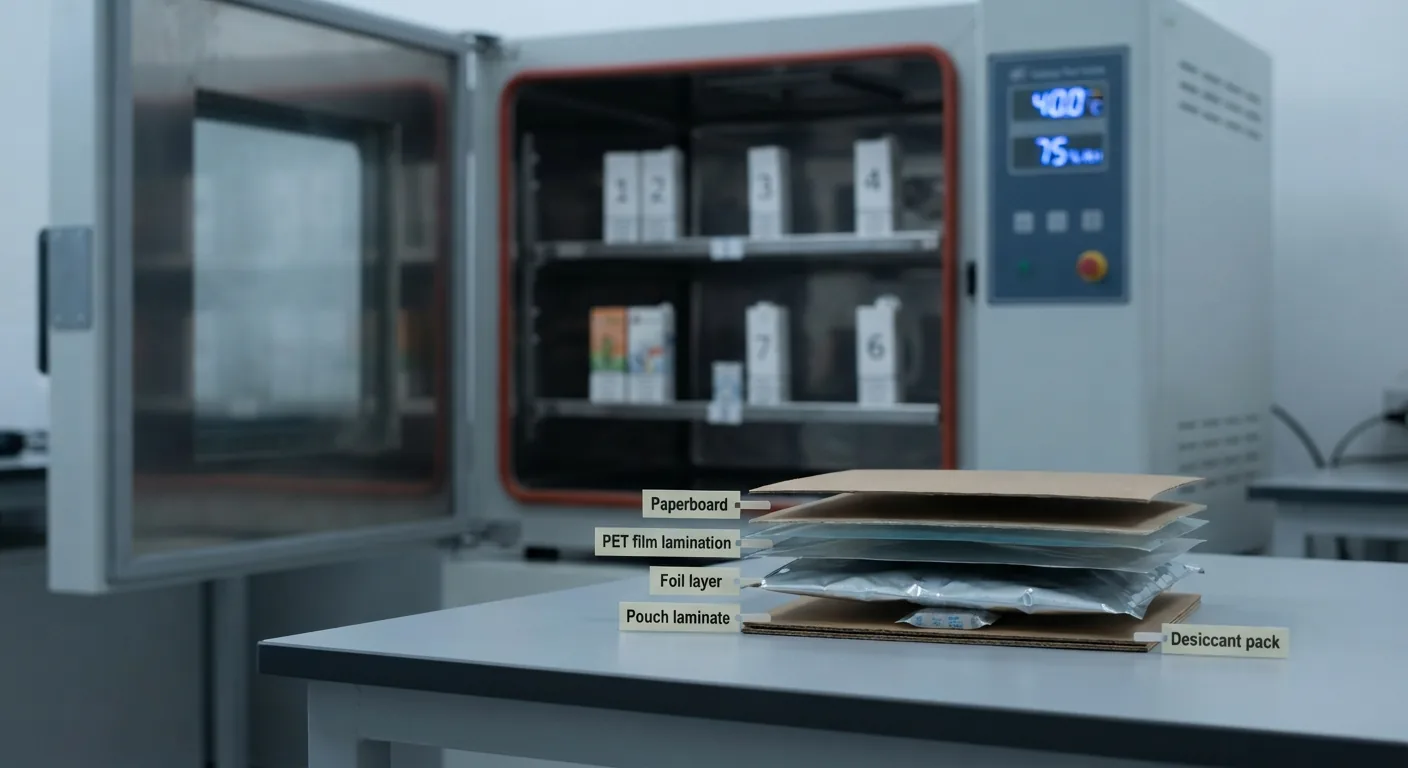
Moisture attacks a carton in several places at once: the inner pack, the insert, the pouch, the master carton, and the sea route. A foil-lined carton can pass while a coated board fails at the score lines, so confirm the risk location first.
Build the material decision stack in this order: board grade, coatings or lamination, foil or film layer, pouch laminate if used, insert material, case-pack protection, and desiccant or secondary-wrap controls.
Board behavior changes with fiber source, so fold-test any kraft or corrugated swap on the real blank before you commit.
For U.S. PMTA records, prepare product drawings, component lists, child-resistant and tamper-evident descriptions, and technical references. The FDA PMTA guidance expects substantial product detail, and I keep a one-page checklist taped inside our compliance binder.
For EU, UK, and Canada, keep the signed proof, closure spec, batch-code sample, supplier declarations, and market variants in one auditable folder. The physical pack and the paperwork must always match, and a missing adhesive declaration once delayed a UK shipment by six days.
Sustainability nuance: if the brand claims FSC, recycled, plastic-free, biodegradable, or compostable, procurement must keep evidence tied to the exact substrate. For an FSC claim, a signed, substrate-specific declaration under FSC-certified packaging belongs in the same auditable folder.
Method diversity: the primary route is one harmonized structure with market-specific artwork variants.
The alternative is separate structures for markets whose stamp, toxicity, or warning-panel demands differ. It costs more tooling, but it prevents failures when warning areas differ by more than 15% of the panel.
After assembly, run a humid-route simulation at 40°C and 75% relative humidity for 72 hours.
Check for crisp folds, dry inner surfaces, intact seals, no foil cracking on scores, and no softened corners; if any corner softens, the barrier failed.
⚠️ Experience Warning: A coated board with a 2-micron film passed lab tests but cracked at the score lines after 14 days of sea humidity. We switched to 12-micron PET lamination and added a desiccant; $0.03 per pack eliminated the failure, so never skip humid-route sampling.
Step 5: Run the Factory-Floor Pre-Press Verification
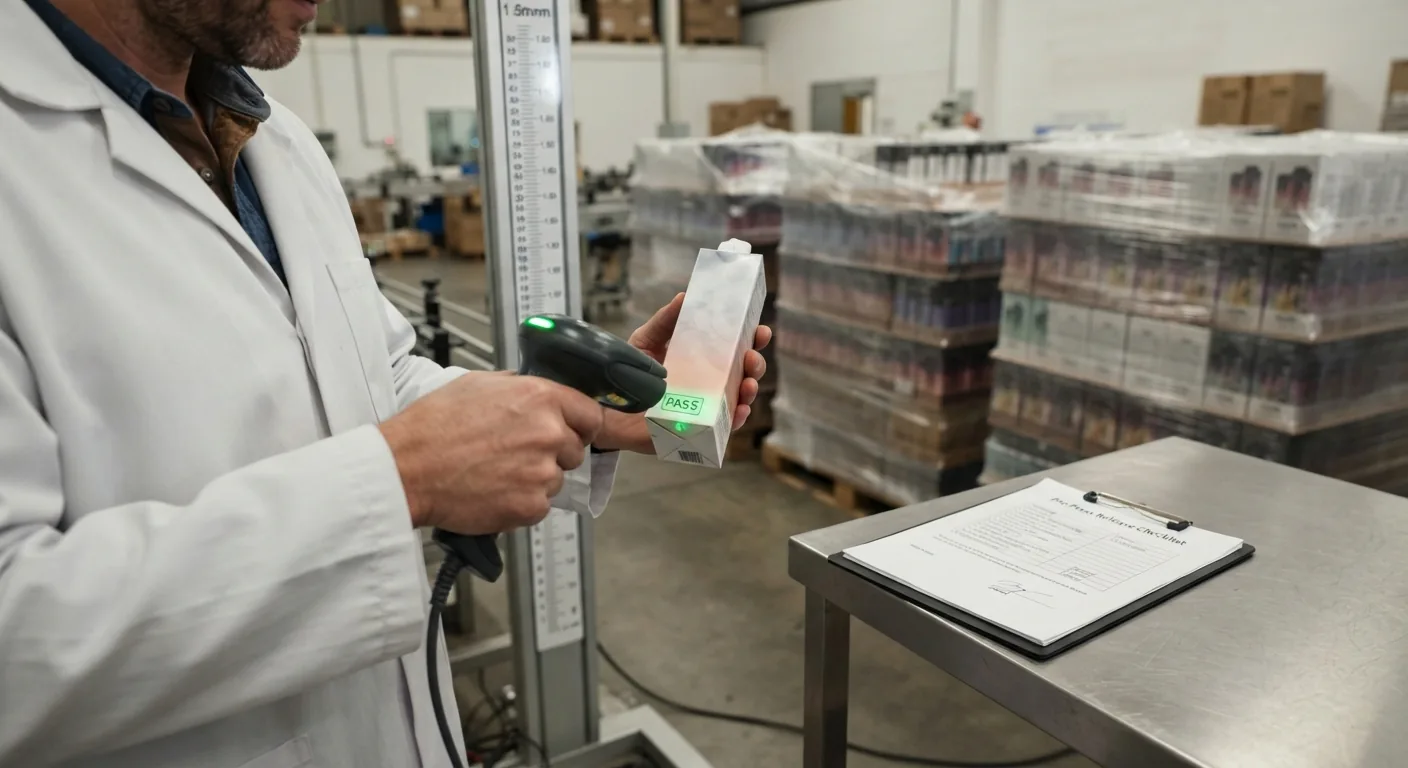
On the Wuhan floor, I sign off only after I hear the CR lock click, watch the tear strip snap once, and check the carton scuff pattern after a 1.5-meter drop. Under warehouse lighting, I confirm the batch code is sharp at arm’s length.
Five-stage pre-press compliance SOP:
- Regulatory file check: the regulatory lead matches each SKU to the market matrix.
- Structural prototype approval: the structural engineer verifies the CR mechanism against the relevant market standard and listens for the lock click.
- Prepress artwork check: the prepress lead checks the warning panel, tactile marker, barcode quiet zone, and market language.
- Pilot-run QC: the QC lead runs 1.5-meter drops, barcode scans, rub tests, tamper-evident tear-strip checks, and an AQL 2.5 seal and batch-code inspection.
- Final release sign-off: the line supervisor confirms the variant and the export coordinator files the evidence.
Q&A with Jacky Chen, Product Manager:
Q1: What fails most often?
Warning-panel geometry and market variants. I personally check the CR click, tear-strip separation, and scuff pattern before release.
Q2: What does your QC lead scan twice?
Every batch code, because dim light hides blur on the second look.
— Jacky Chen, Product Manager
Internal data block: across 400+ custom vape packaging runs in 2025–2026, 62% of client-submitted artwork files failed the initial compliance check. The top four defects caught before print were:
- Warning panel under 30% or 2 mm short.
- Missing tactile warning.
- Barcode quiet-zone intrusion.
- Wrong market language or variant.
Use this locked SOP as a floor reference; our services team archives every signed sample.
⚠️ Experience Warning: We caught a 2 mm warning-box shortfall only on the 100% proof, and a sharp batch code on screen still looked blurry on carton board. Always test physical packs.
🧠 Author’s Take: Release checklist: approved sample archived, test evidence filed, no unresolved regulatory comments, correct variant per market, and a named shipment-release owner.
Four Repeat Failures in Vape Packaging Regulations by Country
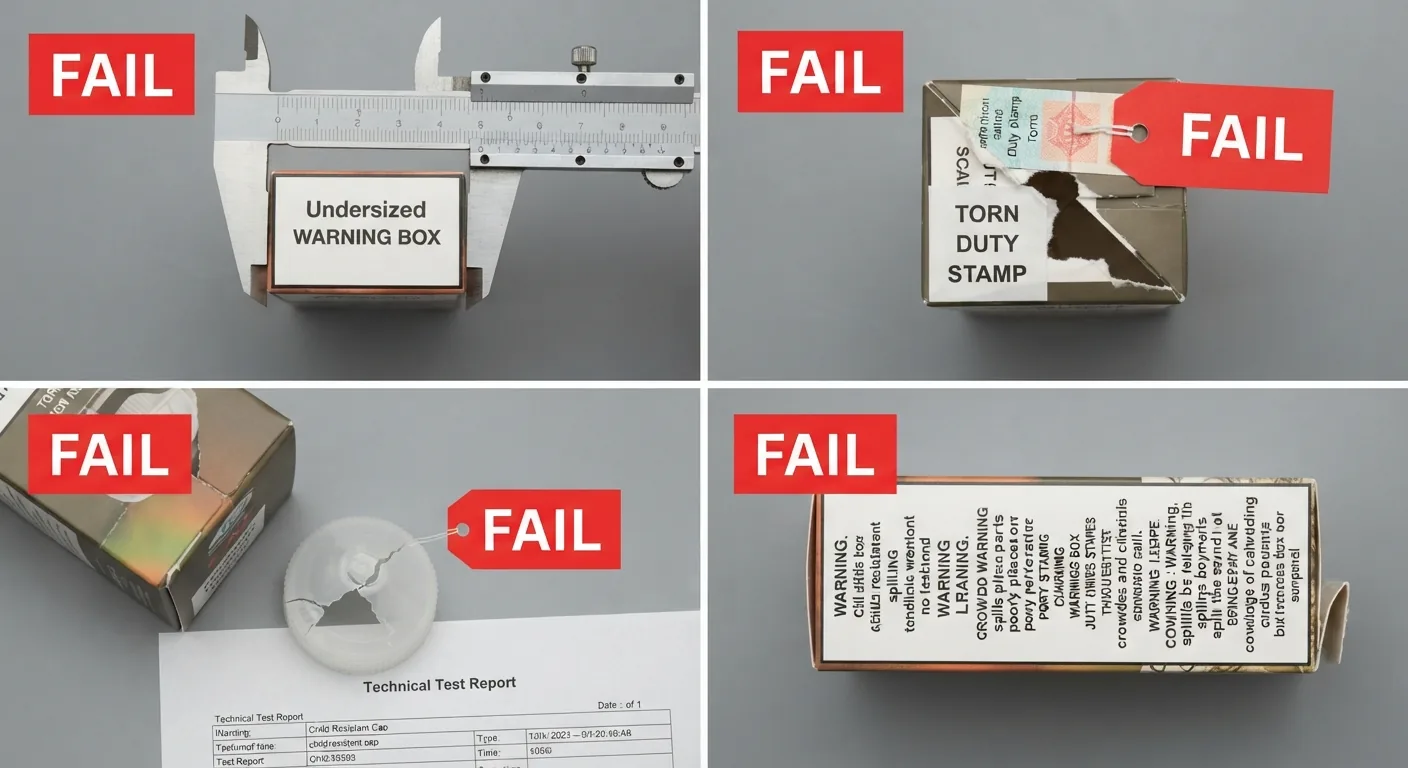
We audited 12 vape launches and 400+ pre-press files, and four failures repeat.
1. Warning Area Is Undersized or Misplaced
Problem: the brand proof looks right, but the warning area or mandatory text is undersized or misplaced.
Why it happened: artwork started flat, not from measured PDPs.
Factory fix: move the warning up 2 mm, widen the left panel 3 mm, and shift the tactile marker to the lower-right.
Prevention control: measure the 30% frame on a 100% proof. Our EU near-miss was 2 mm short and cost eleven days.
2. UK Duty Stamp Seals the Opening Path Incorrectly
Problem: the stamp covers required copy or tears on first open.
Why it happened: the dieline had no stamp bridge.
Factory fix: reroute the stamp across the opening path and move the batch code to the bottom panel.
Prevention control: add an HMRC stamp-bridge layer before art. The outermost pack must not open without damaging the stamp or pack.
3. ISO 8317 Certificate Mistaken for U.S. Proof
Problem: the buyer assumes ISO 8317 satisfies the U.S.
Why it happened: the importer lacks protocol-backed 16 CFR 1700.20 support and certification records.
Factory fix: change the CR vendor and run protocol-backed testing.
Prevention control: file CPSC 1700.20 certification before print.
4. Canada Copy Grows Past the Panel Footprint
Problem: bilingual or toxicity content does not fit the chosen bottle or carton.
Why it happened: copy was added after the dieline lock.
Factory fix: resize the carton or rearrange the panels.
Prevention control: split the SKU by market and run a short digital batch. Health Canada ties packaging, nicotine limits, child resistance, and toxicity copy together under its product safety regulation.
Last quarter, a UK carton returned from customs because the stamp lane was missing, and the return freight hit $2,400.
Conclusion
Your pack is now approved structurally, graphically, and operationally for the target markets. Keep the momentum: duplicate the matrix for the next country, turn the checklist into supplier scorecards, and book formal rule-review dates on your compliance calendar.
I built this SOP from our internal pre-press workflow, anonymized production teardowns, and 2025–2026 QC notes across 12 vape launches and 400+ files.
Send your next dieline through our contact page for a pre-press review before you commit to print.
🧠 Author’s Take: The fastest compliance check is a 100% scale proof with a named owner on every matrix row; screen checks miss 2 mm shortfalls.
Disclaimer: LeelinePackage shares manufacturing and compliance workflow experience. We do not sell paid rankings of regulations, and this is not jurisdiction-specific legal advice. I receive no manufacturer payment.
People Also Ask About Vape Packaging Regulations by Country
1. What is the first step to make vape packaging compliant for multiple markets?
Start with a market compliance matrix, not artwork. Build one row per country, SKU, and pack format, and name the warning rule, child-resistant rule, language set, duty stamp, owner, and Go/No-Go status on each row.
Tag every rule as Active Law, Enforcement Guidance, or Proposal; duplicate sheets cost us more delay than missing data.
2. Are vape products required to have child-resistant packaging in the U.S., EU, UK, and Canada?
Yes. All four markets require child-resistant packaging for nicotine vapes, but each tests to a different standard. The U.S. relies on protocol-backed 16 CFR 1700.20 testing under the CPSC, while the EU and UK cite EN ISO 8317, and Canada models its rules on the CCCR, 2001.
A single ISO 8317 certificate does not satisfy U.S. proof, so file the market-specific evidence before print; the CPSC child-resistant packaging FAQ explains the protocol.
3. How do I test child-resistant vape packaging before mass production?
Test a physical prototype, not a digital mockup. Press the push-and-turn cap, listen for the lock click, pull the tear strip, and check adult opening force. A 4.2 N force failed our adult panel twice before we retuned to 6 N.
Use ISO 8317 as an engineering reference but file protocol-backed 16 CFR 1700.20 proof for the U.S.
4. What nicotine strength and warning-panel size does each market require?
The EU and UK cap nicotine at 20 mg/mL under TPD Article 20 and TRPR 2016. The EU health warning covers 30% of the two largest external surfaces, and some member states require more, up to 65%.
In the U.S., the statutory nicotine warning covers 30% of each principal display panel under 21 CFR 1143.3. Canada also caps nicotine at 20 mg/mL and adds a bilingual warning and a toxic-hazard symbol.
5. Does Canada require bilingual warnings, and when do UK duty stamps apply?
Canada requires the health warning in both English and French on the main display panel, plus the nicotine concentration and a toxicity warning with a hazard symbol; the bilingual copy usually drives the panel footprint. See Health Canada's product safety regulation.
The UK requires HMRC duty stamps on packs released from 1 October 2026. The stamp must sit on the outermost pack and bridge the opening path so the pack cannot open without damage, as the HMRC duty-stamp rule explains.
6. Can one vape carton legally ship to both the U.S. and the EU?
Rarely. The warning geometry, language, and child-resistant evidence differ by market: the U.S. wants 30% on each principal display panel with 16 CFR 1700.20 proof, while the EU wants 30% on its two largest surfaces, with some member states higher, and ISO 8317 evidence.
Most programs ship one harmonized structure with market-specific artwork variants, or split the SKU when warning areas differ by more than 15% of the panel.