

If your packaging claim can’t survive a retailer questionnaire or a customer screenshot, it is a liability. Sustainable packaging is no longer just a design trend. It is a strict procurement requirement.
Many brands assume all “recyclable” cardboard is equal. It is not. Without a verified Chain of Custody, you cannot prove the origin of your material. This exposes your business to regulatory risk and consumer backlash.
Real sustainability requires rigorous verification rather than just earth-toned ink.
The scale of the Forest Stewardship Council (FSC) proves that ethical sourcing is now an industrial-grade ecosystem. By the end of 2025, FSC-certified forest area surpassed 171 million hectares and Chain of Custody certificates exceeded 68,000 worldwide (FSC.org).
Understanding the specific FSC certified packaging benefits allows you to secure market access and build brand trust.
At LeelinePackage, we act as structural brand architects. We ensure your boxes protect the product, elevate the unboxing experience, and satisfy compliance teams simultaneously.
Here is exactly what we will cover:
- The Labels: The critical differences between FSC 100%, FSC Mix, and FSC Recycled.
- The Chain of Custody: How to ensure your certification remains valid from the paper mill to your warehouse.
- The Buyer’s Checklist: How to verify suppliers and specify materials without compromising structural strength.
Sustainability is now a technical specification. It requires the same precision as flute thickness or compression strength.
If you want help specifying FSC materials for your dieline and shipping tests, talk to a packaging engineer.
What is FSC Certified Packaging?
The Forest Stewardship Council (FSC) is a global certification system that verifies sustainable sourcing. While the primary FSC certified packaging benefits include environmental protection and brand trust, the system is fundamentally about traceability.
Think of FSC certification as a passport for your packaging. It tracks wood pulp from the forest through every processing stage to our factory floor. This guarantees your materials never originate from illegal logging or protected conservation zones.
FSC-certified packaging consists of forest-based materials like corrugated board or paper. However, a product can only carry the label if it is produced by an FSC-certified facility under Chain of Custody rules.
You cannot simply buy FSC paper and print the logo yourself; the chain must remain unbroken.
The Three FSC On-Product Labels
- FSC 100%: Contains 100% virgin material from FSC-certified forests. This is rare in high-volume industrial packaging. (us.fsc.org)
- FSC Mix: The industry standard we print most often. It mixes FSC-certified fiber, recycled materials, and/or FSC Controlled Wood. (fsc.org)
- FSC Recycled: Made from 100% recycled fiber. This is the preferred choice for brands targeting a circular economy. (us.fsc.org)
What is Controlled Wood? You will often see “Controlled Wood” listed as an input for FSC Mix.
This is uncertified material that is risk-assessed to exclude “unacceptable sources.” It ensures no illegally harvested timber or genetically modified trees enter the supply chain, even if the fiber isn’t fully certified. (us.fsc.org)
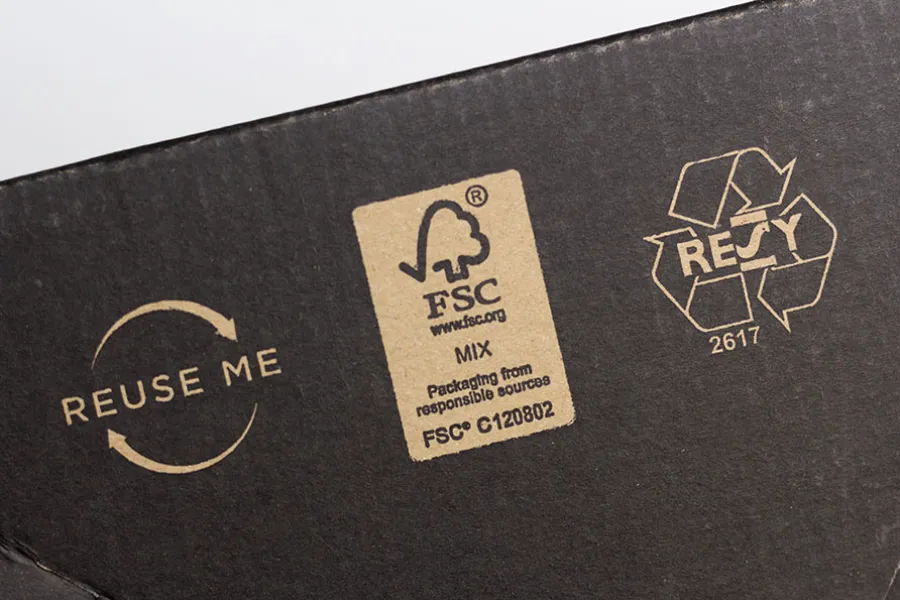
Verifying Your Packaging To avoid greenwashing, we advise clients to look for three non-negotiable elements on their packaging proofs. A generic tree icon is not compliance. A valid claim requires:
- The FSC Logo: The official checkmark-and-tree symbol.
- The Label Type: Clearly stating 100%, Mix, or Recycled.
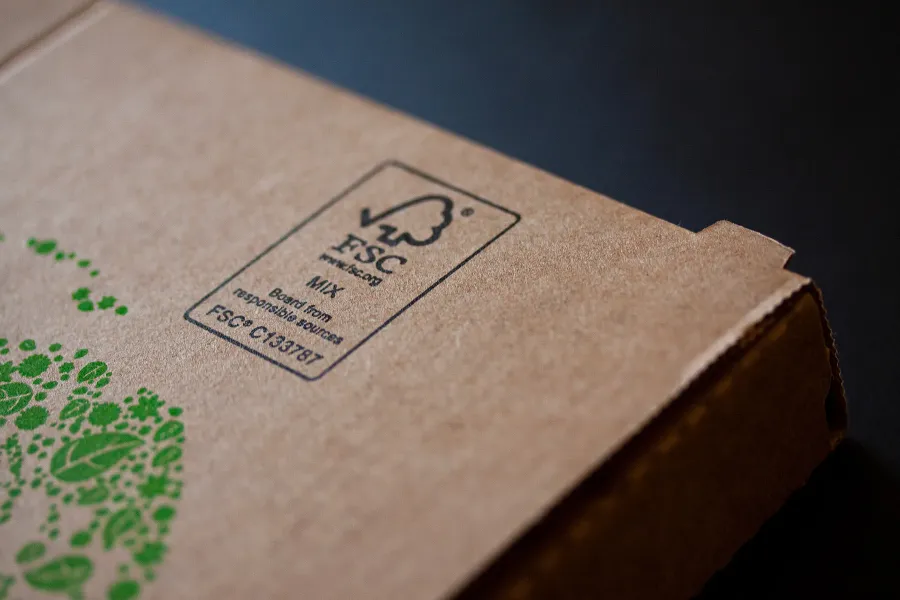
- The License Code: A unique identifier (e.g., FSC® C123456) that links the product to the authorized manufacturer. (my.fsc.org)
💡 Key Insight: Owning FSC-certified paper does not make your packaging certified. The final converter (the factory) must hold a valid Chain of Custody certificate to legally apply the FSC logo to your design.
Core Concepts: How the FSC “Chain of Custody” Actually Works
Most brands treat Forest Stewardship Council (FSC) certification as a simple logo acquisition task. This is a strategic error. When you strip away the marketing, the FSC system functions as a forensic data trail.
It operates like a relay race: if one runner (the supplier) drops the baton (the documentation) or isn’t registered to run, the entire team is disqualified. The final product cannot legally carry the label, and your brand risks a public compliance failure.
To realize the full FSC certified packaging benefits—traceability, compliance, and brand reputation—you must visualize your supply chain not as a static list of materials, but as a flowing river of verifiable data.
3.1 The FSC System: A Step-by-Step Flow
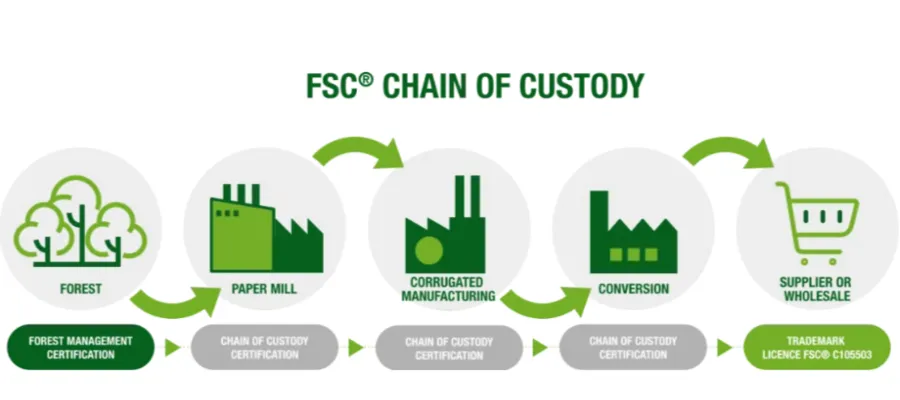
For a box to arrive at your warehouse with a valid claim, the “identity” of the wood fiber must remain intact through every mechanical transformation. Here is the operational flow we monitor during production:
- Certified Forest Management: Loggers harvest trees from an audited forest, tagging the timber with a unique ID.
- Pulp & Paper Production: The mill processes timber into large paper rolls (the raw input), transferring the ID to the new batch.
- Board Conversion: The corrugator bonds three layers of paper (liner and fluting) to create corrugated sheets.
- Printing & Finishing: The manufacturer cuts, prints, and glues the sheets into boxes. (Critical Failure Point: If this factory does not hold a CoC certificate, the chain breaks here).
- Packing & Fulfillment: The manufacturer packs the finished boxes for distribution.
- Your Customer: The end-user receives the verified package.
The Golden Rule: Ownership dictates responsibility. Every legal entity that takes ownership of the product and modifies it (cuts, reprints, repackages) must hold their own FSC Chain of Custody certificate.
3.2 Chain of Custody (CoC): The Administrative Backbone
Chain of Custody (CoC) is a management and recordkeeping standard, not just a material sourcing rule. It ensures that certified material is identified and segregated from non-certified material throughout the factory floor.
When we implement CoC, we essentially run a mass-balance calculation. If we procure 10 tons of FSC-certified paper, we are authorized to sell exactly 10 tons of FSC-certified boxes. Any discrepancy triggers an audit failure.
For procurement teams building Standard Operating Procedures (SOPs), you must align with the normative standards. Currently, we operate under Version 3-1, but standards evolve. Always verify your supplier is auditing against the current version.
- The Rulebook: FSC-STD-40-004 V3-1 (Chain of Custody Certification) – This standard dictates how we track material.
- The Interpretation: FSC-DIR-40-004 – This directive clarifies how rules apply in specific manufacturing scenarios.
- The Mix Mechanism: FSC-STD-40-005 (Controlled Wood) – This allows manufacturers to mix certified fiber with uncertified fiber that has been screened to exclude illegal or controversial sources. This balance is what allows for “FSC Mix” products.
🧠 Expert Insight: FSC is currently revising CoC standards for 2025. Procurement directors should regularly check the FSC Revision Dashboard to ensure long-term contracts remain compliant.
3.3 The FSC Proof Pack: What to Collect From Suppliers
Do not rely on a verbal “yes” from a sales rep. To make your packaging strategy audit-proof, request this specific “Proof Pack” before issuing a Purchase Order.
Auditable Checklist:
- [ ] Valid FSC Certificate Code: The code (e.g., XXX-COC-000000) must belong to the direct supplier invoicing you.
- [ ] Scope Coverage: The certificate must explicitly list the product class (e.g., “Corrugated Paper Packaging” or “P4.3”).
- [ ] Purchase Invoices: The line item must explicitly state the claim (e.g., “FSC Mix 70%”) and the certificate number.
- [ ] Label Approval Proof: A PDF proof showing the correct placement of the FSC logo, label type, and license code, approved by the certification body.
3.4 How to Verify an FSC Claim in 10 Minutes
You don’t need to be an auditor to catch a fake certificate. Use this 3-step validation process for every new supplier.
Step 1: Check the Database Navigate to the FSC Public Search. Enter the supplier’s license code. If the status reads “Suspended” or “Terminated,” halt the process immediately.
Step 2: Match the Product Scope Click into the certificate details. Does it list “Packaging and wrappers” or “Corrugated paper”? We frequently see traders with a certificate for office paper attempting to sell packaging. This is invalid scope.
Step 3: Audit the Artwork Ensure the on-product label matches the material. You cannot print an “FSC 100%” logo on a box made from “FSC Mix” board. The paperwork and the print plate must mirror each other.
- Reference: FSC On-Product Labeling Guidance
3.5 Component-Level Guidance: Choosing the Right Material
Not all packaging components are equal candidates for FSC certification. We analyze components based on structural needs and fiber availability to determine the best approach.
| Packaging Component | Best FSC Approach | Why? (Technical & Commercial) |
|---|---|---|
| Shipping Cartons (RSC) | FSC Mix or Recycled | "Mix" offers longer virgin fibers for stacking strength; "Recycled" supports circularity claims. |
| Custom Mailer Boxes | FSC Mix | Balances the need for a smooth virgin fiber surface (for high-res printing) with sustainable inputs. |
| Tissue Paper | FSC Recycled | Since tissue carries no structural load, use 100% recycled fiber. It feels softer and reinforces the eco-narrative. |
| Hangtags / Inserts | FSC Mix | Virgin fiber is required for stiffness and crisp, bleed-free printing on small cards. |
| Poly Mailers | N/A | Plastic cannot be FSC certified. Bridge Strategy: Use types of plastic packaging materials like GRS-certified recycled content. |
⚙️ Technical Detail: When sourcing custom corrugated boxes, we typically recommend FSC Mix for the outer liner to ensure your branding prints sharply, while using recycled fiber for the inner fluting.
3.6 Sourcing Workflow: How to Compare FSC Suppliers (Scorecard)
When evaluating custom box manufacturers, use this scorecard to rate their capability. A supplier might offer a lower unit price, but if they fail on compliance, the cost of a recall or reputation damage is infinitely higher.
- Certificate Validity (Pass/Fail): Do they hold their own active CoC code?
- Labeling Capability (1-5): Can they digitally imprint the unique license code on every unit automatically?
- Strength Testing (1-5): Do they have an in-house lab for ECT (Edge Crush Test) and BCT (Box Compression Test)?
- Supply Consistency (1-5): Do they have contract-guaranteed access to FSC paper mills (crucial during peak season shortages)?
- Audit Readiness (1-5): Can they produce a “traceability report” for a specific batch within 24 hours?
By treating FSC certification as an operational workflow rather than a marketing sticker, you insulate your brand from risk and ensure your packaging performs as well in the supply chain as it does on the shelf.
FSC Certified Packaging Benefits: ROI Beyond the Label
Adopting FSC standards is not just an act of corporate citizenship; it is a strategic calculation. In our experience manufacturing for global brands, we see certification function as a dual-purpose asset: it is both a shield against risk and a catalyst for market entry.
Here is how verified sustainable packaging generates measurable business value.
1. Credible Sustainability Claims (Reduces Greenwashing Risk)
Regulators are cracking down on vague terms like “eco-friendly.” Without proof, these claims are legal liabilities. FSC certification provides the paper trail. Because the Chain of Custody (CoC) tracks every transaction, you possess a verified audit trail.
You don’t just claim sustainability; you prove it with a license code tracing back to the forest floor.
2. Instant Brand Trust & Conversion
Shoppers make split-second decisions. The FSC “checkmark and tree” is the most globally recognized shorthand for responsible forestry. We find that displaying this mark actively converts “eco-curious” browsers into buyers by validating their purchase decision instantly.
According to FSC consumer research, trust in the label correlates directly with increased brand preference.
3. Verifiable Support for Responsible Forestry
Your procurement budget actively funds biodiversity protection and indigenous rights rather than illegal logging. FAO data confirms that certified management is essential for reversing global forest loss trends.
This allows you to report tangible positive impact in your annual CSR statements.
4. Procurement & Retailer Readiness
Major retailers (like Sephora, Target, and Whole Foods) now demand detailed ESG reporting. Instead of scrambling for data, FSC certification answers vendor questionnaires immediately.
It turns a potential barrier to entry into a “checked box,” accelerating your approval process for shelf space.
5. Competitive Differentiation Without Product Overhaul
Reformulating a physical product is slow; upgrading packaging is fast. For DTC brands, switching to FSC materials is the quickest supply chain improvement you can deploy. You can upgrade your brand’s ethical standing in a single production run.
Nuance: FSC Isn’t the Whole Sustainability Story
We value transparency over hype. FSC guarantees Responsible Sourcing (where it comes from), not End-of-Life (where it goes).
- The Reality: If you cover an FSC box in heavy metallic foil or plastic lamination, it may no longer be recyclable.
- The Solution: Pair FSC materials with circular design principles—like water-based inks and mono-materials—to align with EPA sustainable materials management frameworks.
Challenges & Limitations: The Reality of Sourcing FSC
Transitioning to FSC packaging builds brand equity, but it introduces friction into the supply chain. Through our manufacturing audits, we have identified specific bottlenecks that procurement teams must anticipate. It is not as simple as checking a box on an order form.
Cost Realities & MOQ Friction
FSC certification adds cost, but rarely for the reason buyers expect. The raw timber cost is comparable; the premium comes from segregation labor. Mills must stop production lines to clean machinery and document certified batches separately.
- The Impact: Because of this downtime, mills often enforce higher Minimum Order Quantities (MOQs). In our quoting process, FSC 100% orders often require 5,000+ units to justify the setup, whereas FSC Mix is available at standard 500-unit tiers.
- 🛡️ Mitigation: Request three specific quotes: Non-certified, FSC Mix, and FSC Recycled. Compare the total landed cost to expose the “setup premium.”
Availability Constraints
Sourcing FSC 100% (fully virgin certified fiber) is operationally difficult. Global supply of certified virgin pulp is limited and regional.
- The Delay: In our experience, specifying FSC 100% for niche board grades (like heavy-duty double-wall) can add 3–4 weeks to lead times.
- The Fix: We advise clients to validate FSC Mix for high-volume runs. It stabilizes supply by blending certified fiber with controlled wood, ensuring production lines keep moving during peak seasons.
Performance: The “Crush” Risk
Sustainability cannot compromise structural integrity. FSC Recycled fibers are mechanically shorter and weaker than virgin fibers due to repeated pulping.
- The Failure Point: Our compression tests reveal that swapping a standard virgin box for a 100% recycled equivalent results in a 15–20% drop in stacking strength. If you stack these pallets too high in a humid warehouse, the bottom boxes will buckle.
- The Fix: You must over-engineer the paper weight. We increase the paper grade (GSM) of the recycled board to match the strength of a standard box.
- For structural guidance on avoiding crushed boxes, review our guide on custom corrugated boxes.
Greenwashing & Legal Liability
The most dangerous risk is administrative. Misusing the FSC logo is a trademark violation that can lead to product recalls or lawsuits.
- Common Mistake: We frequently reject artwork where a brand places an “FSC Recycled” logo on a box made of “FSC Mix” material. The label must match the raw material invoice exactly.
- Regulatory Watch: The FTC Green Guides actively monitor these claims. Using the logo without a valid Chain of Custody (CoC) is a primary trigger for “Greenwashing” investigations.
Operational Mitigation Checklist
To realize FSC certified packaging benefits without the headache, integrate this checklist:
- Lock Specs: Define strength targets (ECT) before selecting the label type.
- Verify Scope: Ensure your supplier’s certificate explicitly covers “Packaging,” not just “Paper.”
- Audit the Proof: Match the license code on your artwork against the supplier’s active certificate.
- Standardize Storage: Keep CoC documents in a single digital repository for rapid retrieval during ESG audits.
For standard shipping box education, see our breakdown of RSC corrugated boxes.
Ultimately: FSC Is Your Supply Chain’s Passport
Sustainable packaging is no longer a “nice-to-have” design feature; it is a license to operate in top-tier retail. However, a logo without a paper trail is a liability.
Our final verdict is clear: FSC certification is a sourcing discipline, not just a sticker. While the administrative rigor of maintaining a Chain of Custody (CoC) creates initial friction, it is the only way to future-proof your brand against greenwashing accusations and regulatory crackdowns.
In our manufacturing experience, the “perfect” sustainable box balances three factors: Credibility, Availability, and Physics.
- FSC Mix remains the pragmatic choice for high-volume custom corrugated boxes, offering the virgin fiber strength needed for global shipping.
- FSC Recycled is the ethical gold standard, but it requires precise engineering to prevent crushing.
- FSC 100% is a luxury specification best reserved for boutique, low-volume runs due to supply constraints.
Your 4-Step Action Plan
If you are ready to transition your packaging program, follow this execution roadmap:
- Audit Your Components: List every fiber-based asset (shippers, mailers, tissue, hangtags).
- Select the Claim: Assign FSC Mix to structural boxes (for strength) and FSC Recycled to non-load-bearing items like tissue or inserts.
- Verify the Chain: Before issuing a PO to a custom box manufacturer, demand their CoC certificate and a digital proof showing the correct license code.
- Pilot & Test: Run a 500-unit pilot. Subject these boxes to ISTA drop tests to ensure the sustainable board grade survives the journey.
The Outlook: With regulations like the EU Deforestation Regulation (EUDR) looming, data transparency will soon be mandatory. Brands that build these verification workflows now will secure their market position for the next decade.
If you need help selecting the right FSC material and engineering your boxes to survive transit, contact our team.
People Also Ask About What is FSC Certified Packaging?
Q: Is FSC packaging significantly more expensive than standard packaging?
A: Not necessarily. For FSC Mix, the cost difference is often negligible (1–3%) because the supply chain is well-established. FSC 100% or specific recycled colored stocks can carry a 15–20% premium due to lower supply and higher processing requirements.
In our experience, smart structural design (reducing box size) often offsets the material cost increase.
Q: Can I use the FSC logo if I buy certified paper but print it myself?
A: No. This is a common compliance failure. The FSC Chain of Custody must remain unbroken until the final product is finished and labeled. If you print or convert the box in-house without your own certification, you break the chain and cannot legally use the logo.
You must rely on a certified manufacturer to apply the mark.
Q: Will FSC Recycled boxes be strong enough for heavy products?
A: Only if engineered correctly. Recycled fibers are shorter and weaker than virgin fibers. If you switch to 100% recycled board, we recommend increasing the paper weight (GSM) or upgrading from single-wall to double-wall structure to maintain the same compression strength.
Always perform a crush test before scaling production.