

Short Answer
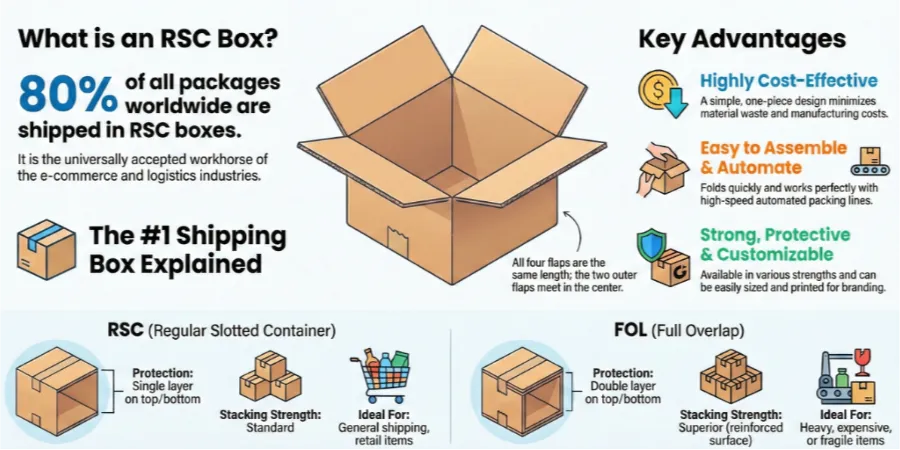
An RSC (Regular Slotted Container), also coded FEFCO 0201, is the standard corrugated shipping box: all four flaps are the same length, and the two outer flaps meet at the center.
It is the most widely used corrugated style, at an estimated 70% or more of industrial corrugated packaging produced.
A PMMI secondary-packaging study found 80% of surveyed companies used RSCs for secondary packaging. RSC boxes fit general shipping, e-commerce, warehouse storage, and master cartons for electronics and appliances.
Move to a full-overlap (FOL) or double-wall RSC when the load is heavy, fragile, or stacked high.
Three specs decide the rest: flute grade, wall construction, and inside dimensions. Settle them before artwork, because each one changes both the price and the protection.
Custom RSC runs start at MOQ 500: a white dummy in 3–5 days and bulk in 4–6 weeks. Our custom corrugated boxes team builds RSC and die-cut styles from the product dimensions outward.
What Is an RSC Corrugated Box?
RSC corrugated boxes are the most common shipping boxes used worldwide. An RSC, or Regular Slotted Container, carries the FEFCO/ESBO code 0201: a one-piece box where all flaps have the same length, and the two outer (lengthwise) flaps meet at the center when closed.
These boxes are made from corrugated fiberboard. The board grade is certified on the Box Maker’s Certificate (BMC), which stamps the ECT rating, maximum gross weight, and size limit on the carton.
They’re known for being cost-effective and durable. Most e-commerce packages you receive arrive in RSC corrugated boxes. Business shipments do too.
Expert Insight: RSC corrugated boxes are the best choice for affordable, flexible shipping. They offer great stack strength, good cushioning, and work well with fast automated packing lines.
For most e-commerce and general distribution applications in 2026, they still offer the best balance between protection, material efficiency, and overall logistics cost.
May Wang, packaging Manufacturer
Key Features of RSC Corrugated Boxes
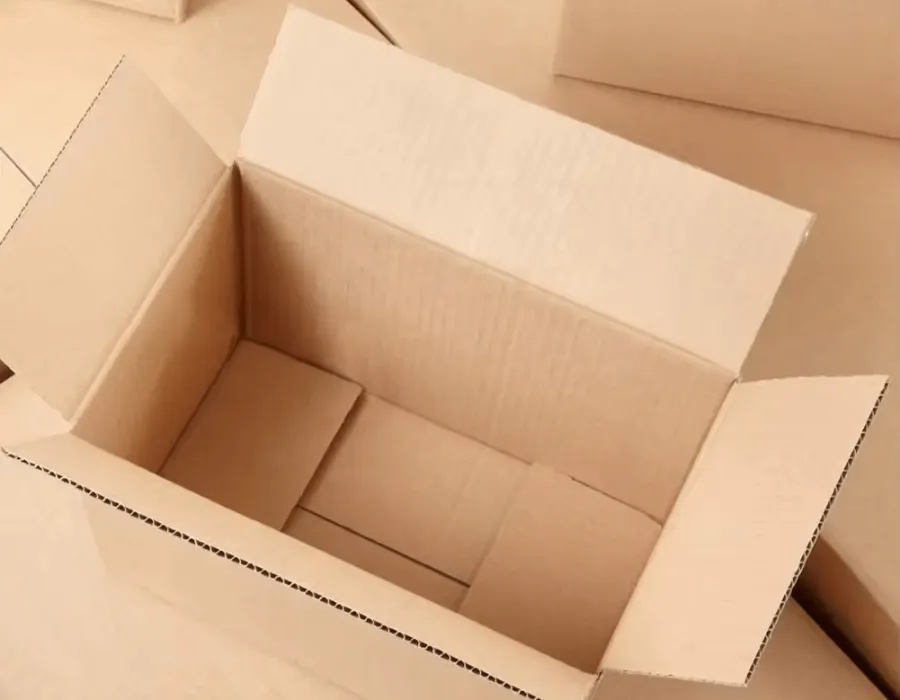
RSC boxes work well for many businesses. Here is what makes them useful for shipping, storage, and e-commerce.
- Classic design with four flaps on both the top and bottom — all flaps are the same length, and the two outer (major) flaps meet neatly in the center when closed.
- Made from a single piece of corrugated board — simple, one-piece construction with minimal material waste during manufacturing.
- Highly cost-effective — among the most economical options due to efficient material use and straightforward production.
- Easy to assemble and seal — quickly folds into shape and typically secured with tape (manual or automated), making it ideal for high-speed packing lines.
- Excellent compatibility with automation — works seamlessly with case erectors, folder-gluers, and tape sealers in modern fulfillment and manufacturing environments.
- Strong and protective — available in various flute types (B, C, E, etc.) and wall constructions (single, double, or triple-wall) to handle everything from lightweight items to heavy loads.
- Highly customizable — easily adjusted in size, board strength, printing, and branding to meet specific product or brand requirements.
What Are the Standard RSC Box Sizes and ECT Ratings?
RSC boxes are made to order, so there is no single standard size.
Size the box from the inside out: measure the product at its longest, widest, and tallest points, add the insert or cushioning allowance, then add the board caliper twice for the outside dimensions.
In an RSC, length is the flap-running dimension, and the two outer flaps meet at the center along it. Length is therefore always the larger of the two base dimensions.
Common stock sizes sold in the US include 12 × 12 × 12 in, 16 × 12 × 8 in, and 20 × 16 × 12 in. These are distributor stock, not a universal standard.
Worked example: a product at 250 × 180 × 100 mm, with 10 mm clearance on length and width and 15 mm on depth, needs an inside box near 260 × 190 × 115 mm. Add twice the board caliper for the outside size.
Oversizing costs money in parcel freight. Carriers bill the greater of actual weight and dimensional weight, calculated as length × width × height ÷ 139 in inches. A box 2 in too large on every side can raise the billable weight without adding protection.
| Grade | Wall | Max Gross Weight | Max L + W + D | Typical Use |
|---|---|---|---|---|
| 32 ECT | Single (200#) | 65 lb | 75 in | General e-commerce and retail replenishment |
| 44 ECT | Single (275#) | 95 lb | 95 in | Heavier goods and stacked pallets |
| 48 ECT | Double (275#) | 100 lb | 95 in | Fragile or high-value loads |
| 55 ECT | Single (350#) | 120 lb | 105 in | Industrial parts and export freight |
| 71 ECT | Double (500#) | 160 lb | 115 in | Heavy machinery and long transit |
These are the standard Rule 41 / Item 222 limits: for example, 32 ECT single wall is certified for 65 lb gross weight and 75 in combined outside dimensions. Mill and carrier practice can vary, and the stamp on the box governs the shipment.
Flute follows the job. B-flute (about 3 mm) gives a flat print surface for retail boxes, C-flute (about 4 mm) is the general-shipping default, and E-flute (about 1.5 mm) suits inner cartons and fine print.
Our E-flute vs B-flute comparison sorts the two by strength, print, and pallet density. For triple-wall and heavy-duty specs, our corrugated board types guide sorts each by wall count and liner.
When Not to Use an RSC?
- Extreme stacking strength: a full-overlap (FOL) or double/triple-wall carton carries the load better than a stock RSC.
- Premium unboxing: a die-cut mailer or rigid box presents the product; an RSC reads as freight.
- Fragile or high-value goods: a die-cut carton with a fitted insert protects better than a stock RSC.
- Small parcel and subscription boxes: a mailer reduces empty volume and dimensional weight.
Common Uses of RSC Corrugated Boxes

RSC boxes show up in almost every industry. Four areas account for most of them:
- Shipping & E-commerce: This is the standard for sending online orders like clothes, books, and household items. It’s cost-effective and creates little waste.
- Food & Beverage: Commonly used for bulk delivery of canned goods, bottled drinks like wine and beer, and packaged snacks to supermarkets and retailers.
- Storage & Moving: The top pick for home moves and warehouse storage. They are durable and stack well on pallets.
- Electronics & Appliances: Often used as the protective “master carton,” these boxes safely ship consumer electronics, small appliances, and industrial parts to stores.
FOL vs RSC: What’s the Difference?
| Feature | RSC (Regular Slotted Container) | FOL (Full Overlap) |
|---|---|---|
| Flap Structure | Outer flaps meet in the center | Outer flaps overlap completely (width-wise) |
| Protection | Single layer on top/bottom | Double layer on top/bottom (extra cushion) |
| Stacking Strength | Standard | Superior (flat, reinforced surface) |
| Material Cost | Low (Most efficient) | High (Uses more cardboard) |
| Ideal For | General shipping, retail, lightweight | Heavy, expensive, or fragile items |
Choose RSC for general loads. Choose FOL when the carton carries heavy, fragile, or unstackable goods and the extra board pays for the added protection.
How to Choose the Right RSC Box?
An RSC is a template, not a stock item. Four decisions set the price and the protection: buying route, board grade, print method, and order volume. Settle them in this order before requesting a quote.
1. Sourcing Playbook: Board Spec and MOQ
Set the board grade before the price. Write the flute, wall count, ECT rating, and inside dimensions on the inquiry, then state the print method, annual volume, and any FSC or recycled-content requirement. That lets a factory quote the same board instead of a generic “strong carton.”
Stock sizes carry no die and ship from inventory. A custom RSC adds a die and a minimum run, then falls per unit as volume rises. Runs under a pallet usually stay stock; truckload volumes justify the die.
2. Factory Audit SOP
- Request the board grade in writing: flute type, wall count, and ECT or Mullen burst.
- Confirm inside dimensions (L × W × D) on the drawing, not outside dimensions.
- Approve a plain dummy for flap gap, score lines, and squareness.
- Fill a sample to the shipping weight, stack it to the planned height, and leave it for 24 hours.
- Check print registration and color against a signed standard on the production board.
- Keep a signed golden sample for reorders.
3. Landed Cost: Domestic vs. Imported
Compare delivered cost per box at the same board grade, print, and freight, not the quoted piece price. A domestic converter wins on lead time and small runs.
An imported RSC wins on unit cost at volume, but adds ocean transit, a higher minimum, and customs clearance. Because the boxes ship flat, freight per box usually decides the comparison.
4. Role-Based Verdict
General e-commerce shipping: a stock single-wall C-flute RSC. Retail or subscription boxes where print carries the brand: E-flute or a custom-printed RSC.
Heavy, fragile, or high-stacked goods: double-wall or FOL. High-volume automated packing lines: a custom RSC with case-erector-friendly scoring. Cold chain or food: moisture-resistant or wax-coated board.
Conclusion
An RSC is simple by design, and that is why it lasts. Equal flaps, one board, one glue joint: the style carries what it needs and nothing more. It remains the cheapest way to ship most products in a protective carton.
Use it as the default for general shipping and master cartons. Right-size the box before you add cushioning; empty volume costs money in dimensional weight and buys no protection.
Change the flute, the wall, or the flap style when the load calls for it, not before. Need a custom RSC or a die-cut alternative? Talk to our team.
Trust disclosure: LeelinePackage is a commercial packaging supplier. This guide describes standard RSC construction and sourcing checks; confirm exact board grades on the mill certificate before production.
People Also Ask About What Is RSC Corrugated Boxes
1. Why are RSC boxes the most popular type of corrugated box?
They use the least board for a given volume, need one glue joint and two scores, and stack flat before use. That makes them cheap to make, easy to pack by hand or machine, and available in common stock sizes.
Those same traits keep them the default for shipping and storage across most industries.
2. What is the difference between RSC and FOL boxes?
In an RSC the two outer flaps meet at the center, giving a single layer on top and bottom. In a full-overlap (FOL) box the outer flaps overlap completely, giving a double layer and a flatter, stronger surface.
FOL costs more board and suits heavy, fragile, or high-stacked loads.
3. Which flute grade should I choose for an RSC box?
B-flute (about 3 mm) for a flat print surface on retail boxes, C-flute (about 4 mm) for general shipping, and E-flute (about 1.5 mm) for inner cartons and fine print.
Match the wall count and ECT rating to the load, then test a filled sample before the run.
4. What ECT rating should I use for an RSC box?
Start at 32 ECT single wall, the standard BMC grade for 65 lb gross weight and 75 in combined dimensions.
Move to 44 ECT single wall or 48 ECT double wall for heavier goods, and confirm the stamp on the box before the run.
5. Can RSC boxes be custom-printed and branded?
Yes. RSC boxes accept flexographic, digital, and litho-laminated print, and the size, board grade, and flap style can all be customized to the order.
Send artwork and dimensions together so the print position and the flap layout are checked on the same dieline.
6. When should I not use an RSC box?
Skip the RSC when the load needs extreme stacking strength, a premium unboxing experience, or fitted protection for fragile, high-value goods.
A full-overlap carton, die-cut mailer, or rigid box handles those cases better; a mailer also cuts dimensional weight on small parcels.