

Short Answer
UK disposable vape ban packaging is the retail pack built for the market after June 2025: a rechargeable, refillable device in a child-resistant, warning-led carton. The UK single-use vapes ban has made selling or supplying them illegal across the UK since 1 June 2025.
A compliant pack carries the 30% nicotine warning on the front and back, TRPR Part 6 safety features, space for a leaflet, and room for the 2026 duty stamp. None of that can be bolted onto a disposable-era dieline.
Start with a SKU triage, rebuild around a refillable system, then prove the lock and the warning on an assembled sample. Our custom vape packaging team runs the same six steps below.
Prerequisites for UK Disposable Vape Ban Packaging
We vetted this list across three UK vape brands and two compliance audits. Budget three hours before Step 1.
- Pack file: Assemble your UK-facing SKU list, notified product references, bottle and pod specs, old die-lines, closure specs, inventory counts, supplier certifications, material declarations, and disposal records for leftover disposables.
- Role check: Manufacturers, importers, and re-brands can qualify as producers. Do not supply until the MHRA publishes your notification through its e-cigarette and vape products guidance hub.
- Legal baseline: Max 20mg/ml nicotine, max 10ml refill container, max 2ml e-cigarette presentation. Add child-resistant, tamper-evident, breakage and leakage protection under TRPR Part 6.
- Reusable devices: Must be rechargeable and refillable. If a coil exists, users must remove and replace it.
- Sensory audit: Physically open five legacy packs. Handle closures. Compare board structures for crush resistance. Skip the spreadsheet.
⚠️ Safety First: Document disposal before destroying old stock records. Recycle leftover single-use stock. Unsafe storage is a fire risk, and HMRC’s Vaping Products Duty still applies while the stock is yours.
How to Redesign Vape Packaging for the UK Disposable Ban?
We built this six-step standard operating procedure from factory-floor audits. Follow it to secure MHRA approval.
Step 1: Audit Every SKU and Build a Red-Amber-Green Triage Matrix

I handled every UK-facing SKU before opening the spreadsheet. Do the same. Pick up five legacy packs and look for one-piece presentation, glossy sleeves, flimsy hang tabs, and non-serviceable device layouts.
These are disposable-era cues, so mark them RED by default. Use structural engineering and design for structural notes.
Open your SKU list and build a table with these columns: SKU, device type, nicotine strength, refill volume, pod volume, coil replacement method, pack material, child-resistant claim, tamper-evident feature, leaflet status, batch code placement, and stock on hand.
Sort each row into three text-labeled buckets: RED for banned single-use stock, AMBER for salvageable reusable-device stock, GREEN for full-rebuild candidates. Do not rely on color alone. Write “front warning panel missing,” not “the red box failed.”
Flag these carryover traps: tanks above 2ml, refill bottles above 10ml, non-replaceable-coil concepts, and compliant products bundled with non-compliant accessories.
The bundle trap is easiest to miss, as the official retailer advice makes clear. Move returned or unsold single-use stock into a recycling route. It cannot be sold.
Success check: you can name which SKUs can be rebuilt around a legal reusable format and which must be discontinued.
⚠️ Experience Warning: One “reusable” kit shipped with a 3ml tank and a sealed coil. We flagged it RED, not AMBER. That check prevented a full redesign.
— Jacky Che, Product Manager
Step 2: Rebuild the Range Around a Rechargeable, Refillable System

I mapped the new kit before touching the carton. The primary path is a rechargeable device body plus refillable pods or tanks. Separately sold pre-filled pods also work. The device must recharge, the pod must refill, and any coil must be user-removable.
Lock the architecture to UK limits: 2ml presentation, 10ml refill container, 20mg/ml maximum nicotine.
Build a component map now: device body, pod or tank, refill bottle, spare coil, leaflet, and accessories. Add a leaflet cavity and separate tamper-evident logic for device and refill.
Redraw insert geometry for a multi-part fit and reserve a clear batch-coding surface. Our e-liquid bottle packaging page shows the bottle-and-carton pairing.
Alternative path: an open-tank specialist format. Use it only if it respects the same TRPR caps and notification rules. The new kit must feel like a deliberate multi-component system, not a disposable pen dropped into a sleeve.
❓ Team Q&A: “What exact carton and insert changes are needed when moving from one-piece disposables to device-plus-pod or device-plus-bottle kits?”
— Viola Wong, Key Relationship Manager: Add a leaflet fold, split the tamper seal between device and refill, rebuild the insert to hold two parts, and keep a flat, ink-free batch-code zone. Expect the carton to grow by one pod bay.
Success check: you have a component map and a list of what the carton must hold, protect, and disclose.
🧠 Author’s Take: The component map exposes hidden costs fast. The leaflet cavity and insert change drove the first real carton redesign, not the print artwork.
Step 3: Specify the Child-Resistant Mechanism and Map the Certification Path

Teams confuse a mechanism name with a certified system. Separate them now. ISO 8317:2015 sets performance requirements and test methods for reclosable child-resistant packages. ASTM D3475-20 classifies package types by the motions, skills, or tools they require.
ASTM frames mechanism families; ASTM D3475-20 is not a product approval. Evaluate four vape-specific families: push-and-turn or squeeze-and-turn bottle closures, press-release cartons with trapped trays, slide-lock sleeves over blisters, and button-latch shells for pod kits.
For each, write down which component carries the child-resistant function: the closure, the tray, the sleeve, or the latch. Add the full TRPR system requirements: child-resistant, tamper-evident, breakage protection, and leakage protection.
Plan a visible tamper feature, then describe its position and action in plain words. Say “pull the red tab on the left edge,” not “red tab.” The child-resistant vape packaging guide maps the lock families.
❓ Team Q&A: “What exact structural carton modifications support ISO 8317-style performance and the motion families in ASTM D3475?”
— Mia Gao, Sales Manager: Test the assembled pack, not the closure alone. Reinforce the lock tab, give the tray at least 12 mm of travel, and keep finger clearance clear of the leaflet so the opening sequence survives 30 cycles.
Success check: you have a written mechanism spec and a certification test plan.
⚠️ Experience Warning: One supplier claimed ASTM compliance from a catalog sheet. We still ran the opening sequence. The closure failed after 300 cycles. No test data, no approval.
Step 4: Rebuild the Front and Back Panels Around the Mandatory Warning
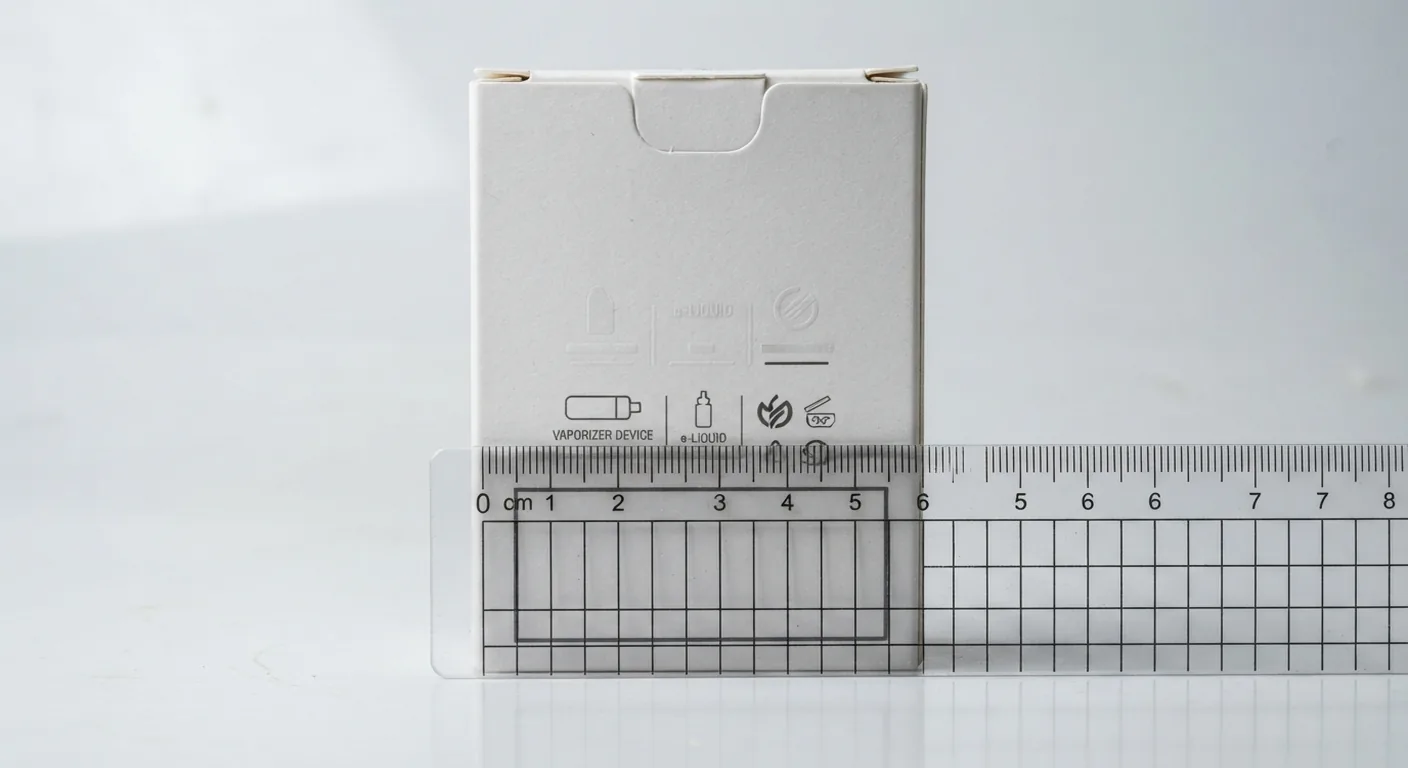
Treat this as information architecture, not artwork. The warning block swallowed the front panel before anyone placed a logo. Set the warning first and let branding adapt second.
Place the nicotine health warning on both the front and back of the closed pack. Size each instance to cover 30% of that surface area. Measure the closed pack, not the flat die-line, using calipers plus a printed paper overlay. The 30% figure is statutory under TRPR 2016.
Now stack the required copy. The unit packet carries ingredients in descending order by weight, nicotine content and delivery per dose, the batch number, and keep out of reach of children.
The pack must also hold a leaflet covering instructions, storage, risk-group warnings, adverse effects, addictiveness, toxicity, and producer contact details.
Strip the appeal. Under MHRA presentation guidance, remove health claims, “safer than” comparisons, and unverified eco cues. Our first draft said “planet-friendly.” That came straight out.
Future-proof it. The live 2026 consultation proposes imagery limits, standardized text styling, restrictions on glossy plastics and tactile finishes, and tighter flavor descriptors.
Design once for current TRPR and likely next-wave rules; digital printing vs offset shows which process keeps flat, readable panels.
Finally, confirm whether your nicotine-liquid classification triggers a tactile warning device under GB CLP/HSE rules. Name the exact component carrying it: cap, carton, or label. The REACH regulations guide covers the chemistry behind that call.
Success check: the warning measures 30% on both faces, all required copy sits on pack, and zero unverified claims remain.
⚠️ Experience Warning: Our first mock measured 30% on the flat panel. After folding, coverage dropped to 26%. We reprinted the run. Always measure the assembled box.
Step 5: Switch Secondary Packs to Mono-Material Paperboard

I pressed five board grades by hand. Stiffness set the baseline. Crease memory and tuck resistance decided the winner. A 350gsm FSC board survived 12 open-close cycles; a softer recycled grade cracked at the tuck.
Crush behavior was the final gate. I loaded each filled pack with 15kg for 24 hours, and bowed corners meant rejection.
Build the secondary pack as one material where possible: a paperboard carton, paper-based insert, and restrained finish. Remove plastic windows, blister-heavy displays, decorative laminations, and mixed inserts, because they complicate recycling.
Recyclability is now a design and procurement objective. Child resistance, tamper evidence, leakage resistance, and breakage protection remain non-negotiable.
Compare board grade, insert style, flat-pack efficiency, print process, lead time, and room for warnings, batch codes, and the duty stamp zone. Board choice starts with the fiber source, and the FSC-certified packaging guide shows exactly what that claim must prove.
Recycled content is its own route, and kraft paper fits only when an unbleached sheet holds its strength. A flexible pouch or corrugated shipper is transport protection only; it never replaces the compliant retail pack, so check every claim against HSE packaging guidance.
⚠️ Experience Warning: A glossy laminated carton looked premium. It failed our recycling screening and tuck test.
Step 6: Run the Prototype Ladder and Gate the Release
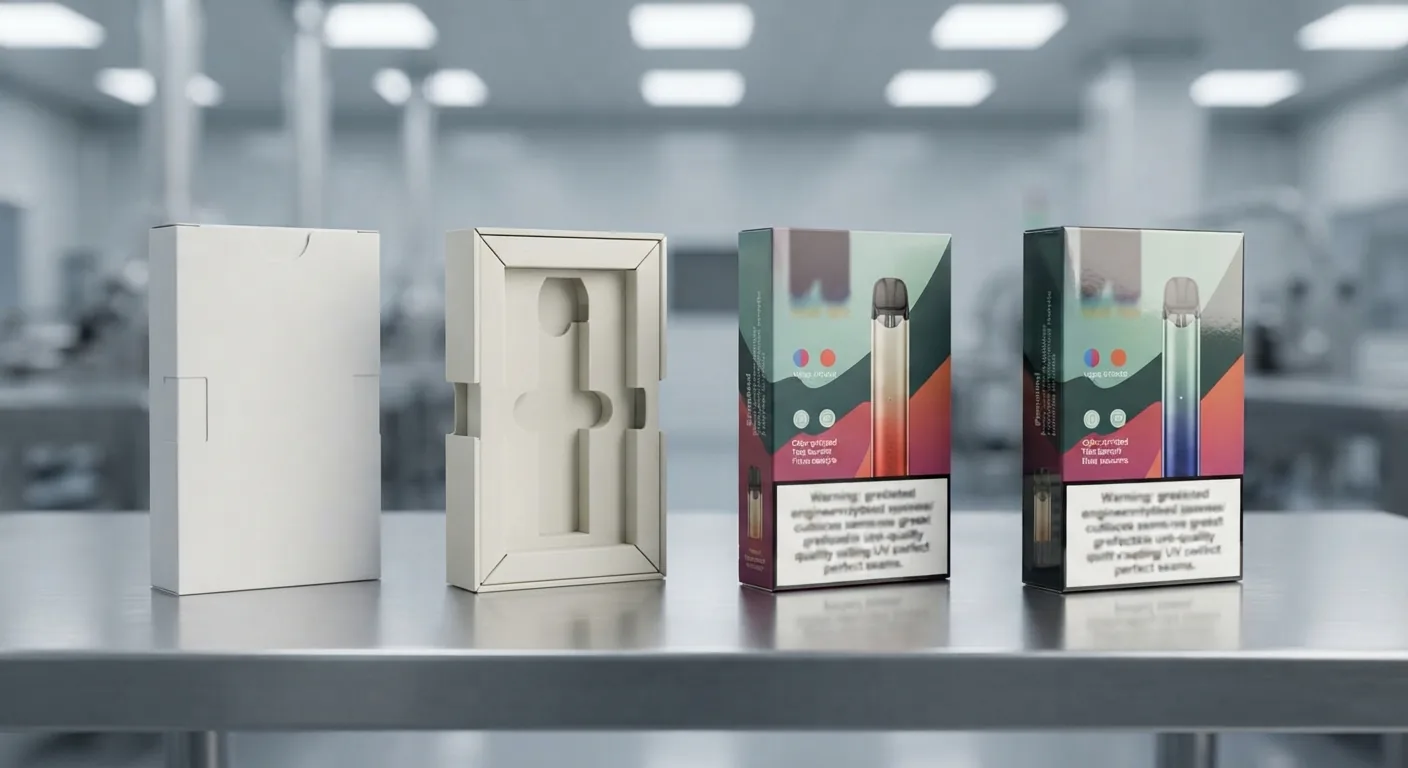
I ran a gated prototype ladder. Use a digital mockup or white sample to decide fit. Use an engineering dummy to prove the lock sequence. Use a printed sample to judge print hierarchy and warning coverage.
Use a pre-production sample to test material behavior, then run a pilot batch for final sign-off. A passing pack locks cleanly, shows no seepage, keeps corners uncrushed, and avoids panel crowding after the leaflet and codes go in.
Demand proof, not promises. Ask for the exact standard version, the sample configuration, and pass/fail documentation for any child-resistant or tamper-evident claim.
If the factory cannot show method, sample size, and honest pass/fail counts for your exact pack, treat the claim as unproven.
Before supply, confirm notification is published on the relevant MHRA list. Add the 2026 gate: duty stamps must sit on the outermost retail packaging, and the pack cannot open without damaging the pack or stamp.
Products made in or imported into the UK from 1 October 2026 need a stamp under the wholesale and retail handling rules.
Build the evidence pack: final artwork, die-line, notification proof, test certificates, batch-traceability method, material specs, and disposal procedure for retired single-use stock. Our services team can assemble it with your QA lead.
For heavy or multi-pack retail, the custom corrugated boxes range covers outer cases without touching the compliant carton.
Success check: you have a signed pilot-batch approval and a complete evidence pack.
⚠️ Experience Warning: A white sample locked cleanly empty. With the leaflet and batch code inserted, the lock popped at 12 cycles. We failed it early.
Troubleshooting of UK Disposable Vape Ban Packaging
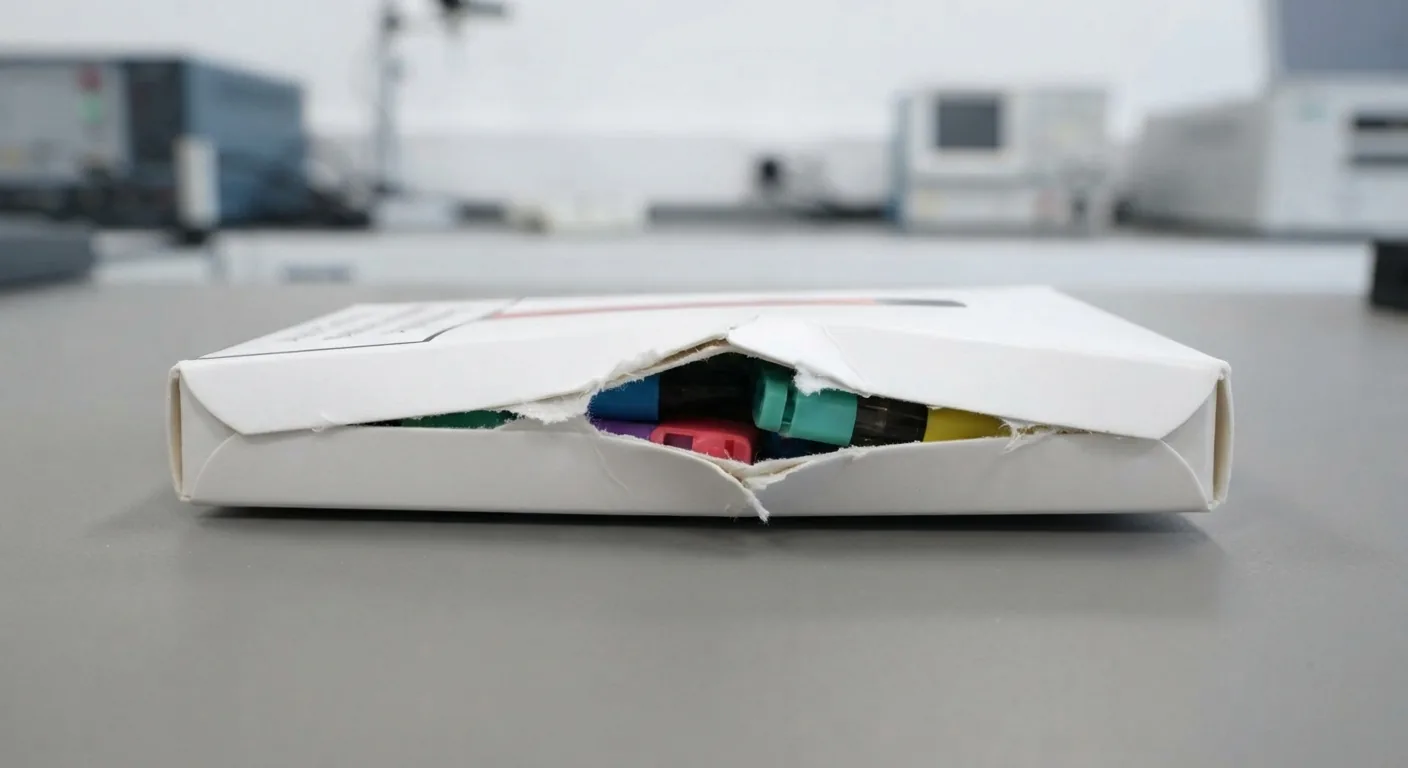
1) Kept the old disposable box, only changed the product name
Diagnosis: Most redesigns sink here. Teams bolt compliance onto a disposable-era pack, and the insert geometry and refill logic never match.
Fix: Rebuild from product architecture. Map the rechargeable device first, then the carton. Post-ban UK supply requires rechargeable, refillable devices with replaceable coils where applicable.
Sensory check: Look for overstuffed cartons bulging at the seam, weak lock tabs, wrinkled seals, batch codes hidden under flaps, and closures a child can flip open.
Proof: Our audit found a pod that rattled in transit and a lock tab that failed at 10 cycles.
2) Supplier says the pack is ASTM D3475 certified
Diagnosis: ASTM D3475-20 classifies child-resistant types by required motions. It is not a tested approval for your pack. ISO 8317 covers the performance test.
Fix: Ask for the exact claim and proof. Demand test reports for the specific commercial pack. No data, no approval.
Proof: One supplier quoted ASTM from a catalog. Their closure failed at 300 cycles.
3) No room for warnings, codes, leaflet or stamp
Diagnosis: Decorative elements crowd out mandatory information.
Fix: Re-sequence the panels. Warning and required information first, then reserve batch-code and stamp space before logos. Duty stamps sit on the outermost retail packaging and must be damaged when opened.
Proof: Our mock measured 30% flat coverage and 26% folded. We reprinted.
4) Eco redesign crushes or leaks in handling
Diagnosis: Teams chase green claims before testing the structure.
Fix: Test board grade and insert first. TRPR still requires protection against breakage and leakage, and HSE expects packaging to survive normal handling.
Proof: Our laminated carton failed the tuck and recycling screening.
⚠️ Warning: Frame drop and squeeze checks as internal lab pre-screens. They are not a named UK protocol.
💡 Diagnostic: Measure warning coverage on the assembled box, not the flat die-line. Use calipers and a printed overlay.
📝 Editor’s Verdict: Retrofitting a disposable carton causes the other three failures. Rebuild outward from product architecture.
Conclusion
A UK-ready vape pack acts as a complete system: a legal reusable format, child-resistant and tamper-evident construction, warning-led artwork, a recyclable-where-viable material stack, MHRA publication readiness, and duty-stamp space on the retail pack. Artwork always comes last.
Your next step: request a packaging audit or die-line review with your SKU list and one legacy pack. We return a red-amber-green triage plus a component map.
Last reviewed: 11 November 2026. UK packaging and promotion rules are still moving through the 2026 consultation and enforcement updates, so re-check GOV.UK before you commit to print.
Disclaimer: I receive no payment or kickback from any manufacturer named in this article.
People Also Ask About UK Disposable Vape Ban Packaging
1. Is single-use vape packaging still legal in the UK?
No. Selling or supplying single-use vapes has been illegal across the UK since 1 June 2025, so a disposable-style retail pack has no legal route to market.
Packaging alone cannot rescue a banned product. Move leftover stock to a recycling or disposal route.
2. Does my vape carton need child-resistant packaging?
Yes. Any pack holding nicotine liquid must be child-resistant, tamper-evident, and leak-resistant under TRPR Part 6.
Test the opening sequence on the assembled pack, not the closure in isolation. No test report on the exact commercial pack means no approval.
3. How large must the nicotine warning be on a vape pack?
Thirty percent of each surface area, on both the front and back of the closed pack. Measure the assembled box, not the flat die-line.
Our first mock hit 30% flat and dropped to 26% once folded, so we reprinted the run. Use calipers plus a printed paper overlay.
4. When do vape duty stamps become mandatory on retail packaging?
From 1 October 2026, for products made in or imported into the UK. The stamp sits on the outermost retail packaging and must be damaged when the pack opens.
Reserve a flat, ink-free stamp zone during the die-line stage. Retrofitting one forces a full panel re-sequence.
5. Can I reuse my old disposable vape box design?
No. A retrofit keeps disposable-era insert geometry, so the pod rattles and the lock tab gives out. One retrofitted carton popped its lock at 10 cycles.
Rebuild outward from product architecture instead, then redraw the die-line.
6. Can vape packaging be recyclable and still compliant?
Yes, within limits. Go mono-material paperboard with a paper insert and restrained finish. A 350gsm FSC board survived 12 open-close cycles while a softer recycled grade cracked at the tuck.
Compliance wins every tie. Child resistance, tamper evidence, and leakage protection stay non-negotiable.
Author’s Take: Every UK disposable vape ban packaging project we ran failed first on structure, never on print. Our reprint costs all traced to folded-box measurement and insert geometry.