≈ 21 mm across · 75 mm tall
- Bottle
- A short glass dropper, or a small PET bottle
- Carton
- A slim carton, one bottle to a box — the lightest in the set to post.

A neck card keeps the cap off the box wall in transit, and runs start at 500 units. 10 ml, 30 ml, 60 ml and 100 ml each get their own die, so the glass does not sit in a loose cavity.
A die is drawn to a bottle, not to a millilitre. Move from 30 ml to 60 ml and the bottle grows taller and wider, and the carton is redrawn rather than stretched. Two weights share a die only when the height and the body diameter both match.
None of the four is a stock die, and the bottle sizes are only a guide. A 15 ml or a 120 ml bottle is drawn to its own die, from the same three numbers.
≈ 21 mm across · 75 mm tall
≈ 30 mm across · 80–105 mm tall
≈ 35–41 mm across · 105–125 mm tall
≈ 39–43 mm across · 110–150 mm tall
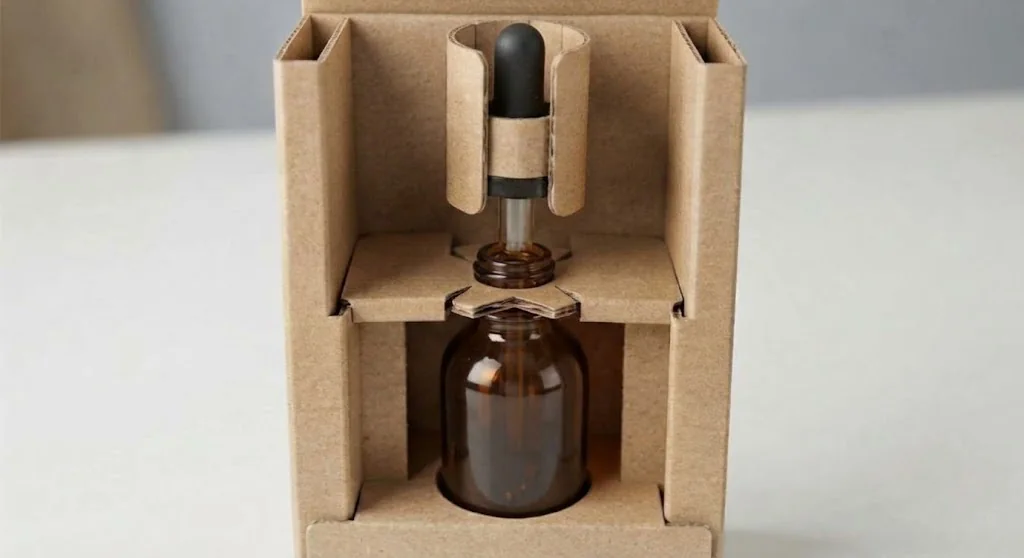
The insert fixes the bottle and nothing else — there is no device slot and no foam bed by default. EVA is not the starting point here; a grip for a single glass dropper, a tray for a heavier base or a carton of several.
Measured at theNECK
A cut card flexes over the neck and keeps the bottle upright. The shoulder and the printed label stay clear of the wall.
Measured at theWIDEST POINT
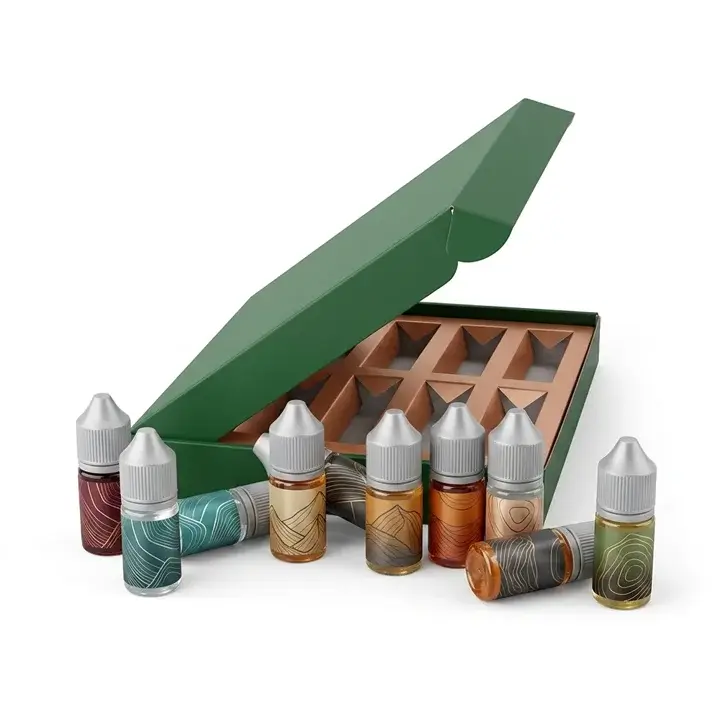
The base sits in a shallow tray that carries the weight, and that sets the pitch once several bottles go into the carton.
Two bottles need a divider, and six need a tray drawn to the count. Changing the count is a new die; settle it before the artwork.
A dropper cap stands taller than the bottle it closes, and the carton is measured to the cap and not to the shoulder. Take the height at the shoulder and the lid rests on the cap, on every unit in the case. Each measurement below decides something the packing line will notice.
A tuck-end carton folds flat and is glued on the filling line. A lid-and-base or tray-and-sleeve carton is formed and loaded, because the insert goes in before the walls close.
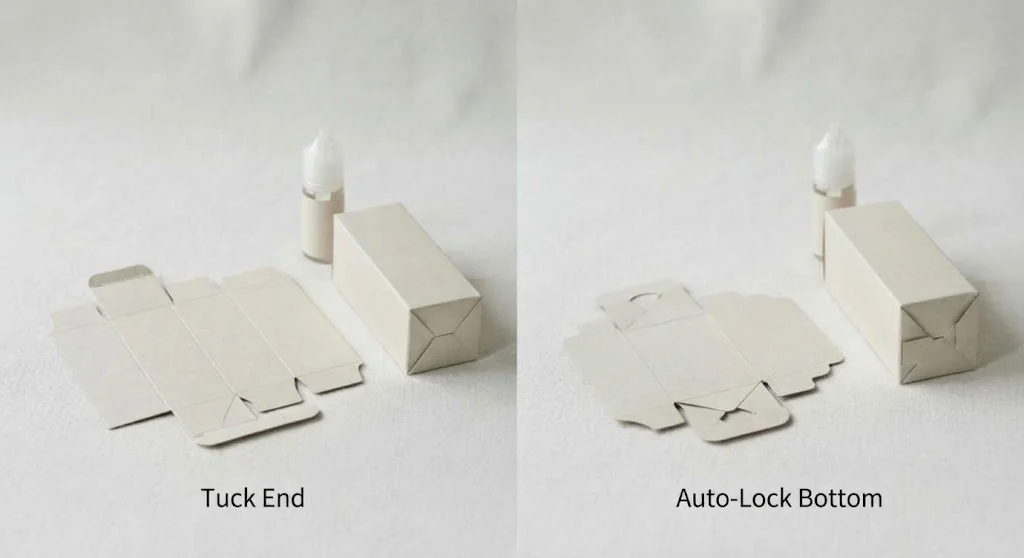
Straight or reverse tuck, glued by machine and folded on the filling line.
Freight is the cheapest of the four, because a stack of blanks ships flat.
Its base folds up under the bottle instead of tucking in.
A heavier glass bottle needs no tray underneath, and the carton stays thin.
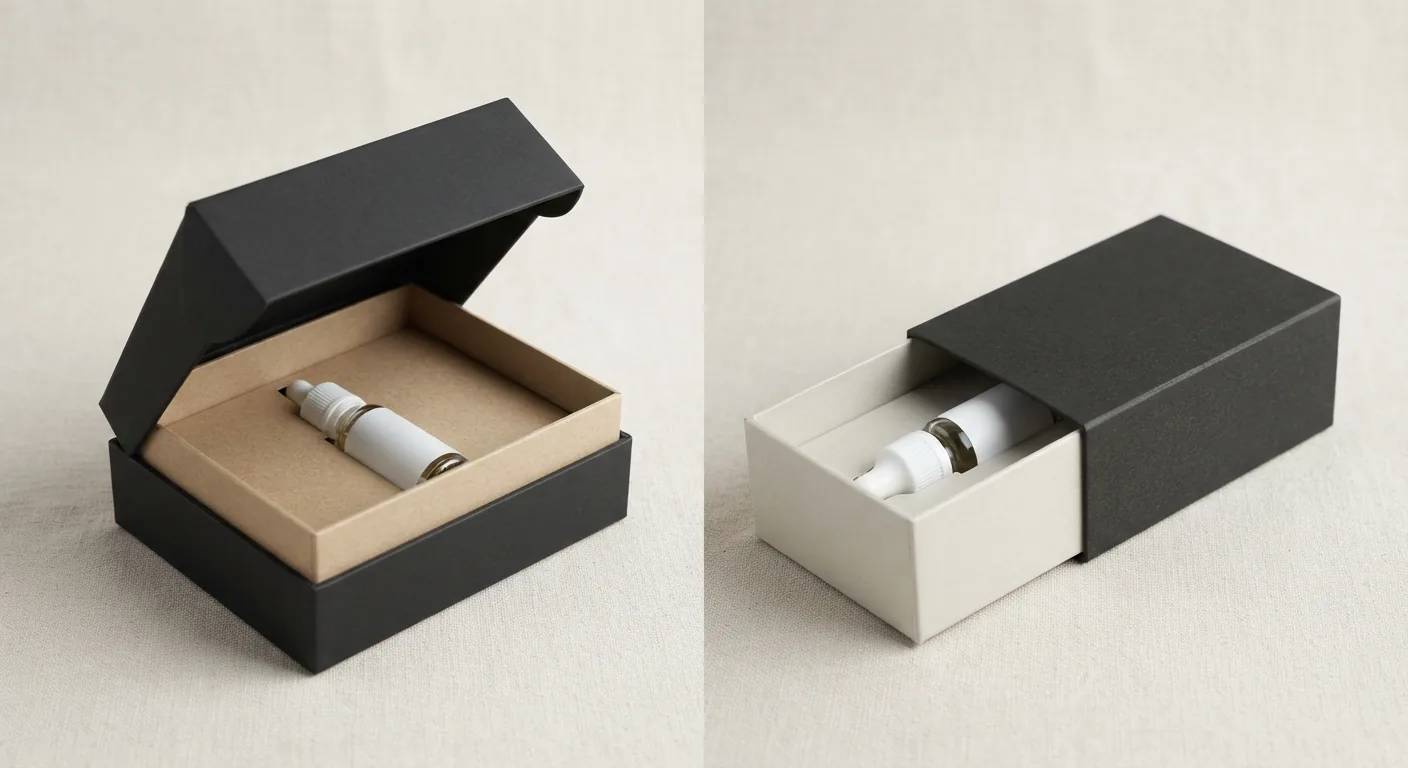
Two pieces, a wrapped base and a separate lid.
Built the strongest of the four, and the shape a gift set reaches for.
A printed sleeve over an insert tray that slides out.
A single pull slides the bottle out, label first, without tipping.
Our first carton was drawn to the shoulder of the bottle, and the dropper cap pushed the lid up by 1.4 mm on every unit. Redrawing the height to the top of the cap closed it flat, and that file has run since.
Reorders go in on the signed file. A run of 45,000 cartons is cut without a new tool, and the neck grip lands in the same place each time.
8 markets now carry the same carton, and none has had its box redrawn since the first order.
A chubby is cut at its widest point. The tray holds the bottle on its own base, and the cap clears the lid by 11 mm.
The multi-bottle tray was drawn to our own count. A full case sits at a fixed 40 mm pitch, and the line packs it in a single movement.
What we did not expect was the window. Cut on the body and stopped below the cap, it shows the fill level on the shelf, and 8,000 cartons later buyers still comment on it.
A window stops at the body and never runs up to the cap. The dropper keeps the wall in front of it, and the label is what the window shows.
Yes, from the full height, the body diameter and the neck diameter, with a drawing of the bottle. A dummy in 3 to 5 days proves the fit before a printed run.
A dieline lands in 24 hours. The white dummy follows in 3 to 5 days to prove the fit, a printed dummy in 7 to 10 days to fix the color, and the bulk run takes 4 to 6 weeks once the sample is signed.
It can. The dieline, the type and the fill-level panel are set on the same file, so the print and the structure are approved together rather than in two passes.
FSC-certified board is standard on request, and a recycled kraft stock is available for the same carton. The choice is fixed on the sample, so a reprint matches.
No. A sealed pen and a 510 cartridge are wrapped by their own drawings, not by a bottle carton. A bottle box is cut to a bottle, and a bottle is all this page covers.
Send the bottle shape. The dieline, the tray and the window come back drawn on one file.