Food & Beverage

Food Packaging That Cuts Spoilage and Transit Damage by 50%

A food or drink brand loses money when a product spoils before its date or arrives crushed and stale. Barrier and seal are tested first — finish comes last — so both risks are closed before the dieline is cut.

Send Your Product Spec

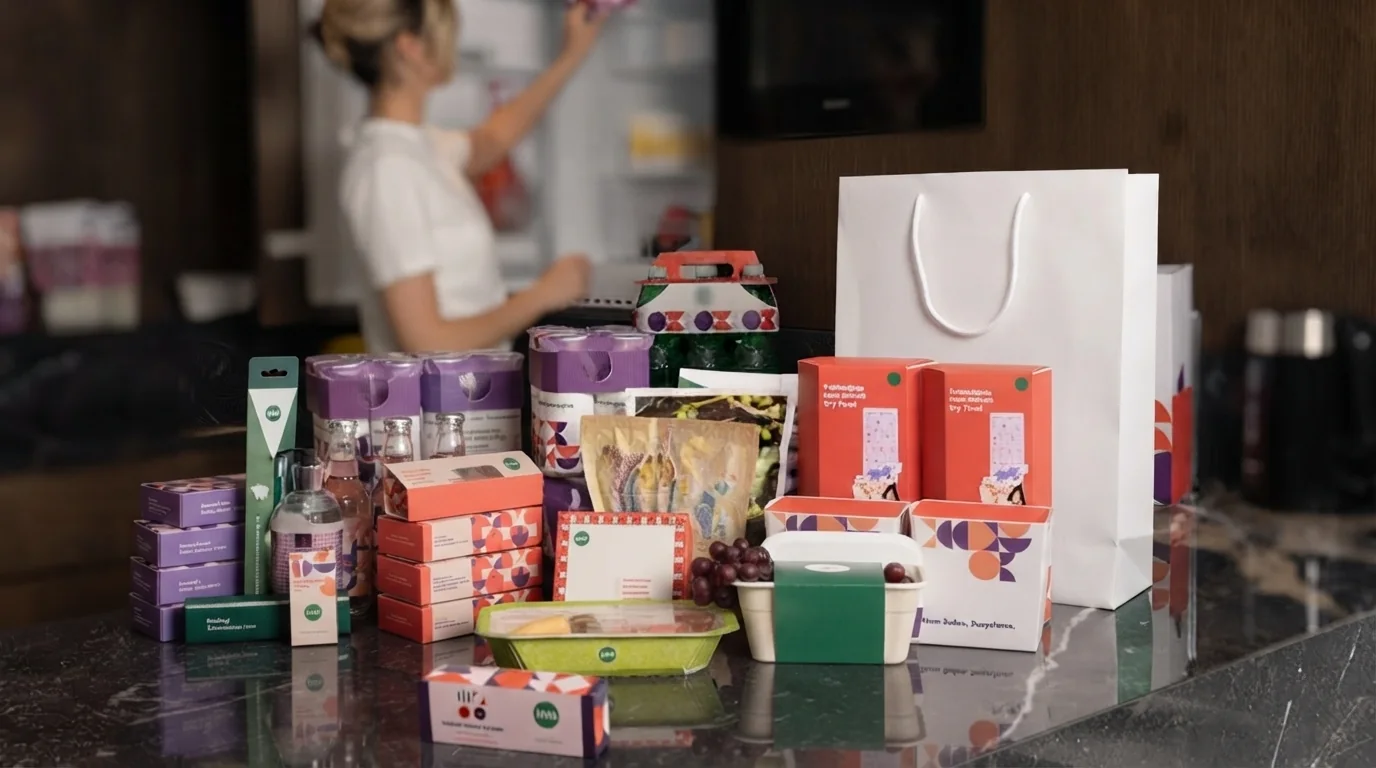
A group of food and beverage packaging — pouches, cartons, trays, a bottle and a shopping bag — set out on a kitchen counter
A real spread of food and drink packaging, shot in a home kitchen.
  • 500units minimum
  • 2markets audited: FDA, EU
  • 4–6 wkto a shipped pallet
  • 99.8%QC pass rate
The product

The Shelf Clock and the Parcel Clock

One pack has to survive two different spans of time. The barrier runs the long one; the structure runs the short one.

On the shelf

Months, under retail light

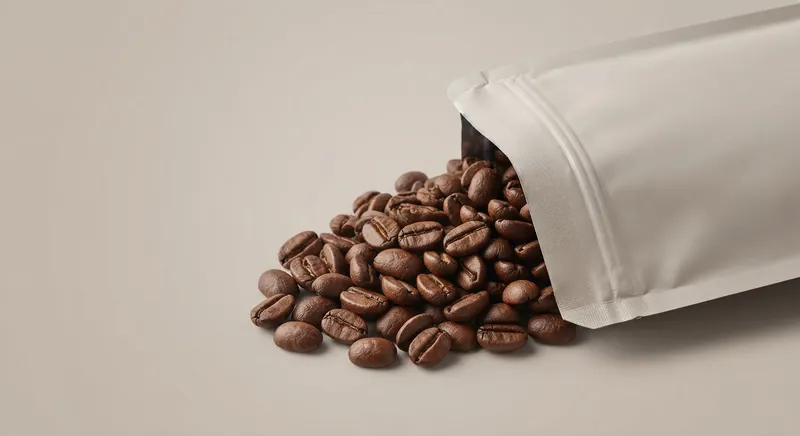
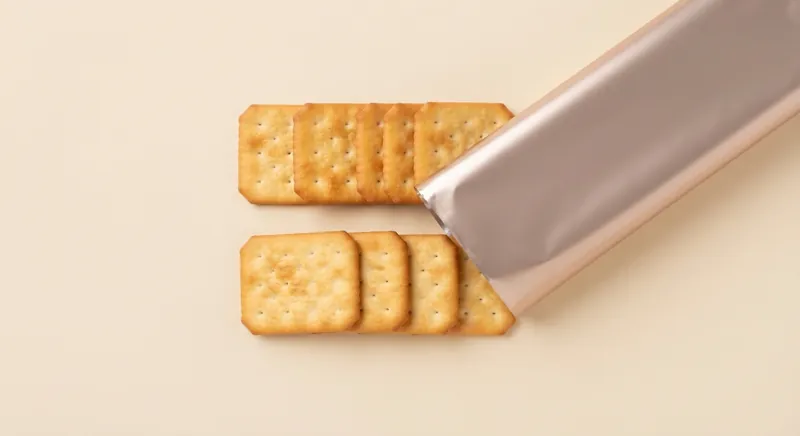
Oxygen, moisture and light work on the product every day it sits on the shelf — long after the shopper has decided to trust the date.

How we close itWe set the barrier to the shelf life on the label, not to a default thickness. The flavor holds to the date on the pack.
In the parcel

2–5 days, under load

The seal, the fit and the board take the sorting hub and the drop — the span a showroom sample never sees.

How we close itWe prove the pack on a loaded sample before the run, not on the showroom shelf. The parcel arrives as it left the line.

Barrier first, structure second, finish last.

Failure modes

Five Ways a Pack Fails

Five mechanisms do most of the damage. Identify the risk that owns the product, and the specification follows from it rather than from a catalogue.

  • Coffee and nuts gone stale inside their pack, the condition a rancidity test catchesOxygen

    Oxidation

    Examples
    Coffee, nuts, oils, whole milk powder
    What goes wrong
    Goes stale, flat and rancid
    The fix
    High-barrier film or foil, plus an oxygen absorber where headspace allows
  • A powder clumped and caked inside its pack after taking on moistureWater vapor

    Moisture

    Examples
    Powders, crackers, biscuits, dried goods
    What goes wrong
    Cakes, clumps and loses its crunch
    The fix
    Metallized or PVDC layer, plus a desiccant where the format needs it
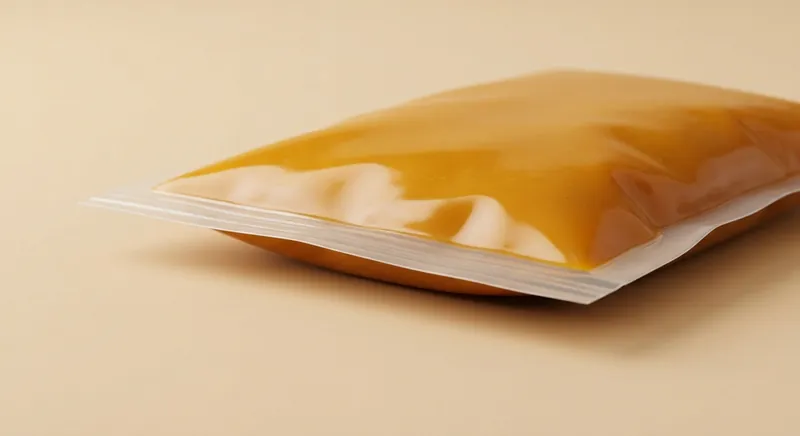
  • A sauce pack seeping at the seal and leaving an oil ring on its mailerSeal

    Leakage

    Examples
    Sauces, oils, liquid-filled packs
    What goes wrong
    Seeps, stains and leaves an oil ring on the mailer
    The fix
    Closure proven in the shipping posture, plus a secondary absorbent pad
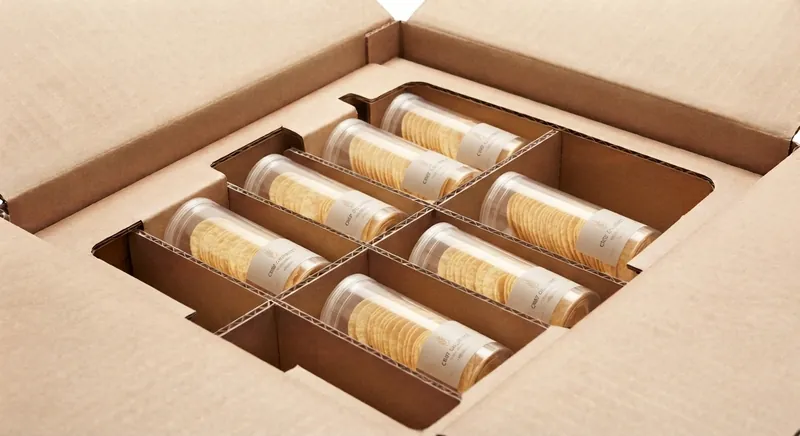
  • A snack pack dented and cracked after a drop in transitStructure

    Crush

    Examples
    Chips, wafer packs, fragile confectionery
    What goes wrong
    Cracks, dents and breaks in the parcel
    The fix
    Cavity or divider that holds position instead of more fill
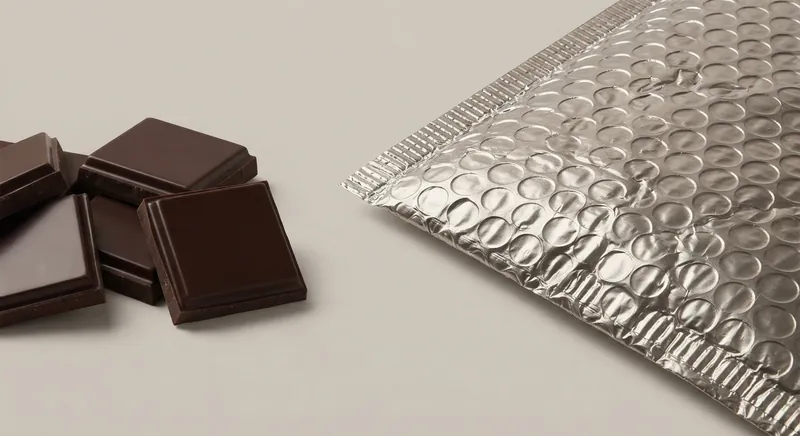
  • Chocolate bloomed and softened after travelling through a warm ambientTemperature

    Heat

    Examples
    Chocolate, dairy, gummies
    What goes wrong
    Blooms, melts and separates on the way
    The fix
    Insulated shipper or a phase-change pack sized to the delivery window
Barrier

Barrier and Structure

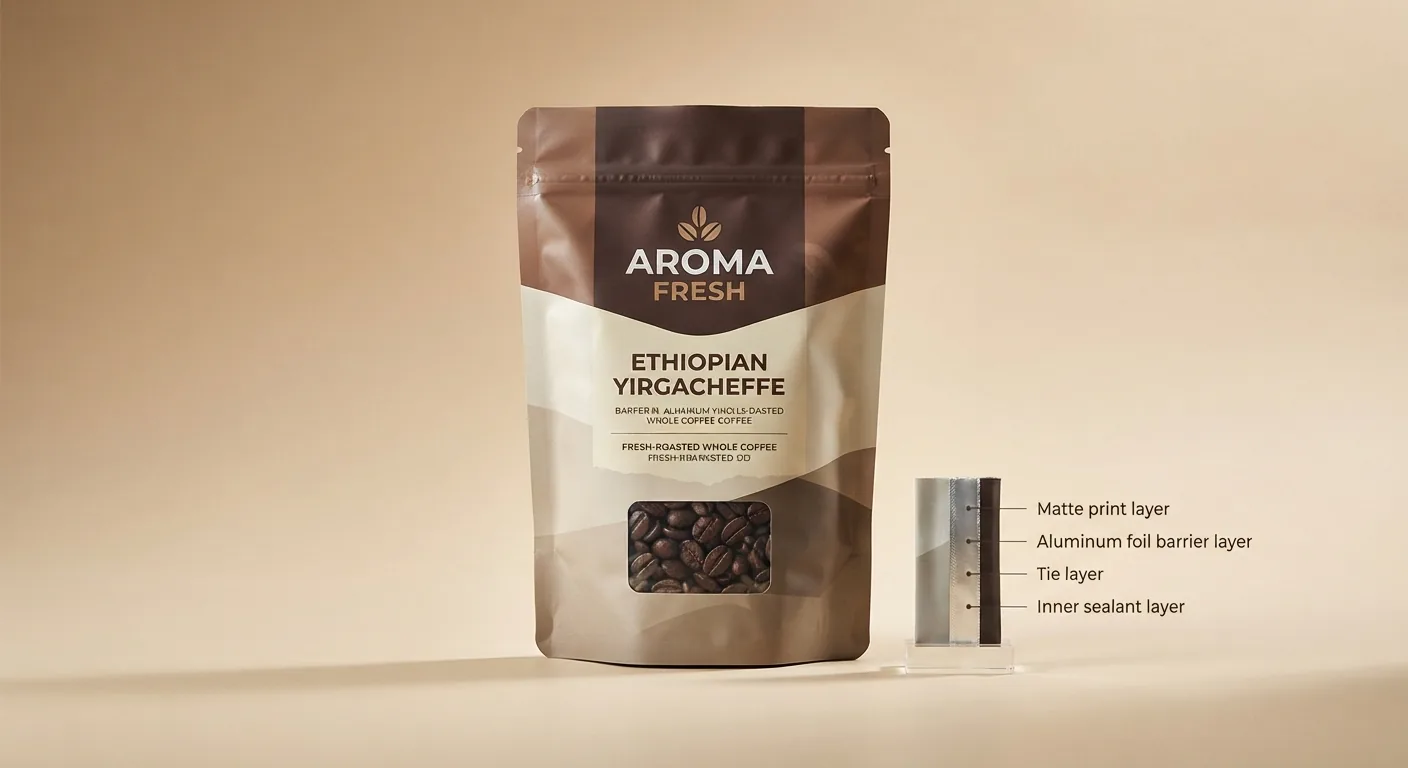
The barrier is a stack, not a wall. We build it outward from the product and spec it against three measured numbers, so the spec is a number, not a feel.

The stack

Built outward from the product. The seal is the weakest layer.

What we spec against

  • 01

    Oxygen transmission

    How much oxygen crosses the film in a day — the number that sets the shelf life of coffee, nuts and oils, so it is chosen against a target, not a thickness.

    OTREVOH · MET-PET · foil · absorber

  • 02

    Moisture transmission

    Water vapor crossing the film decides whether a powder, a cracker or a biscuit stays crisp, and no board grade moves that number much.

    WVTRMET-PET · PVDC · desiccant

  • 03

    Seal integrity

    Proven on a loaded pack rather than a flat bench — and the one number a finish can never rescue.

    Leaktested closure · absorbent pad · cradle

The Seal Decides Most Failures

A perfect film on a weak seal leaks exactly like no film at all. The seal must run through the fold, weld within the filling line’s tolerance, and survive the drop before the board is chosen.

Test the Seal Before Print

Formats

Choosing the Format

The format follows the failure and the channel, not a catalogue. The six fall into three jobs; pick the job first, and pick the pack for what it solves — not for how it looks in a range.

A printed folding carton and a rigid gift box on a plain studio surface

Printed shelf packs

The print faces the shopper, and the parcel still has to survive.

  • Folding carton

    The print has to face the shopper

    A printed folding carton carries the shelf face and the panel over a product already wrapped.

    SolvesA selling face and a label panel without buying, stocking or setting up a second display pack.

  • Rigid box

    It ships as a gift set and is meant to be kept

    A rigid box is a wrapped shell and a lid that outlast the product, so the opening reads as a gift.

    SolvesAn unboxing that reads as a gift, and a box the customer keeps rather than bins by Friday.

A printed stand-up pouch and a vacuum barrier bag on a plain studio surface

Barrier packs

Air, light and moisture are kept out by the film, not the board.

  • Stand-up pouch

    Aroma is lost the moment air gets in

    Resealable, with a printed barrier film and a degassing valve where fresh-roast coffee needs it.

    SolvesFlavor held to the date on the pack, and a pouch the customer can close again after opening.

  • Barrier bag

    Oxygen of any kind spoils it

    Vacuum or gas-flushed, the highest barrier here, for products that spoil on contact with air.

    SolvesThe longest shelf life of the six, for a product that would otherwise spoil on contact with air.

A corrugated shipper and a sealed metal tin on a plain studio surface

Protective packs

The shape is held through transit, or light and time are kept out.

  • Corrugated shipper

    The primary pack must not take the courier network alone

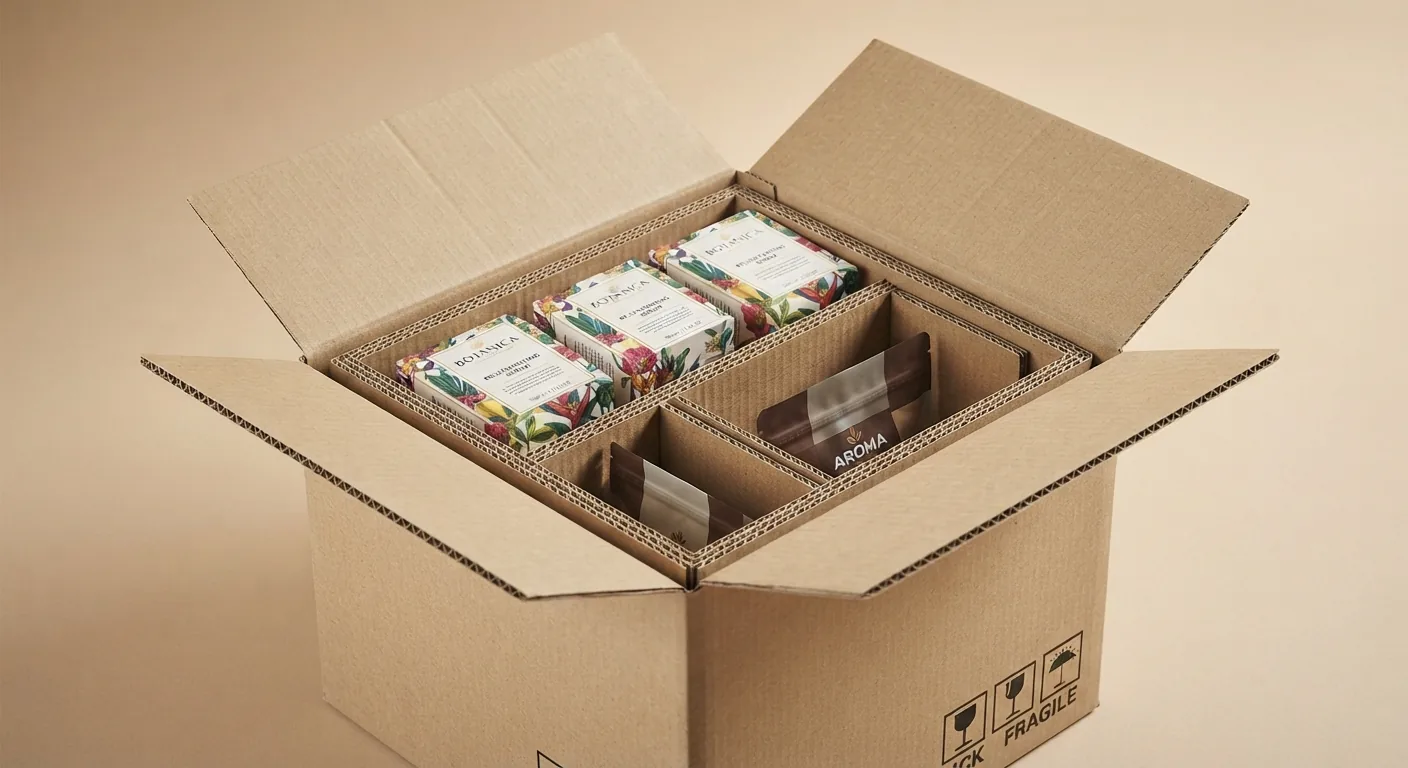
    A corrugated shipper absorbs the stacking and the drop, so the printed pack reaches the door unmarked.

    SolvesA printed pack that arrives unmarked, because the shipper takes the stacking and the drop instead of the product.

  • Tin or can

    Light and time must stay out, season after season

    A metal tin stops light and moisture on its own, for a shelf life measured in seasons rather than weeks.

    SolvesLight and moisture kept out by the metal itself, for a shelf life measured in seasons, not weeks.

PairingHigh-barrier bag keeps it freshCorrugated shipper takes the load

Compliance

Food-Contact Rules in the US and EU

The point is simple: a pack that sells at home can be refused at the border over a coating, an ink or a label line. We check the rules of the market it ships to at the dieline, so the pack clears — not after the container lands.

US

FDA 21 CFR 175 · 176 · 177

Clearance by material family

Adhesives and coatings, paper and board, and polymers that touch food. The panel carries Nutrition Facts, the allergen statement, net quantity and the date.

WatchA finish on the food-contact face needs its own clearance.

EU

EC 1935/2004 · EU 10/2011

10 mg/dm² migration limit

Framework rules for food-contact materials, and the plastics measure. Labeling under EU 1169/2011 sets allergens in bold at a minimum x-height of 1.2 mm, or 0.9 mm on small packs.

WatchThe migration limit applies to the finished article, not the raw film.

Other

Destination declaration

One declaration per SKU

Markets outside these two each ask for a written declaration and their own panel rules. The paperwork travels with the SKU and is set once, not per order.

WatchName the destination before the dieline, not after.

A foil, a lamination or an ink on the food-contact face can put a pack out of compliance even when it looks right — so the panel geometry and the contact face are settled at the dieline. Caught there, a rule is a material swap or a line of type; caught at the port, it is a reprint or a refused pallet.

Check My Pack Against the Rules

Testing

How the Pack Is Tested

The rules on the previous band are proven, not assumed. Four checks run in this order after a 3D mockup comes back in 24 hours: barrier and seal first, appearance last, so a finish is never bought for a structure that does not yet hold.

  1. 01

    Barrier and seal

    A white dummy or a near-material sample goes through a simulated transit. The test is leak and moisture, not appearance.

    Proves The barrier holds3–5 days

  2. 02

    Fit and fixing

    The product is loaded and moved. It must not shift far enough to crack, dent or press a seam open.

    Proves The structure holdsWhite sample

  3. 03

    Compliance

    Material declarations, panel positions and food-contact documents are gathered before any print is released.

    Proves The market accepts itBefore print

  4. 04

    Finish

    Only now are surface treatments chosen, on a structure already proven. A finish is the last layer, not the first fix.

    Proves The finish is safe to add7–10 days

Fixes

What We Fix When It Goes Wrong

Each card walks the same three steps: what is actually happening, the tempting fix that does not work, and the change that does — almost always at the barrier, the seal or the print, not in more board or more fill.

  • Good on the shelf, high damage online

    The display pack is built for a shelf, but the parcel network adds sorting, stacking and drops it never had to survive.

    The TrapAdd more void fill

    Fill cushions the box, not the product — the pack still takes the same drop.

    Our FixSplit display and transport into two packs

    A printed carton for the shelf and a corrugated shipper for the trip, each doing one job.

  • A sustainable swap, and the shelf life drops

    The new material changes the barrier, not just the board.

    The TrapGo to a thinner board

    The board never carried the barrier; thinning it does nothing about how fast the product stales.

    Our FixConfirm the barrier still meets the target

    Re-check oxygen and moisture transmission on the new film, so the date on the pack still holds.

  • It passed the sample, then failed the first run

    The seal was set on a bench, where the dwell time is longer than on the line.

    The TrapBlame the film

    The same film seals fine at the bench; the difference is speed, heat and dwell on the production line.

    Our FixRe-qualify the seal at line speed

    Set pressure, heat and dwell to the real line speed, then test again before the run ships.

  • Fresh-roast coffee balloons the pouch

    Roasted beans keep releasing CO₂ for days after packing.

    The TrapPrick a vent in it

    A hole lets the gas out and the oxygen in, so the coffee stales faster.

    Our FixSize a one-way valve to the roast

    The valve releases CO₂ and blocks oxygen, so the pouch keeps its shape and the flavor.

  • Ink or coating creeps into the seal zone

    Ink under the seam stops the film bonding to itself.

    The TrapVarnish over the whole face

    A coating does not fix a bonding failure; the seam still cannot weld through the ink.

    Our FixKeep the seal lane free of ink

    A clean strip for the seal lets the film bond, and the artwork moves around it.

  • The consumer cannot reseal it after opening

    The zipper was chosen by width, not by the fill weight it has to hold.

    The TrapTape the opening shut

    Tape is single-use and reads as a repair; it gives the customer no way to close the pack again.

    Our FixSpecify a zipper rated for the fill weight

    A zip matched to the load closes cleanly every time, so repeat use is not a broken pack.

Every one of these fixes is decided before the next run, and any of them costs less than the reprint, the reship or the spoiled pallet it avoids.

Send the Problem You're Seeing

FAQ

Frequently Asked Questions

Six answers that come up before a quote is useful. Each changes the specification, not just the price.

Do you supply only the film, or the printed pack as well?

Either. A film on its own is matched to the print and the seal; a film supplied with the pack is tested as one unit, with the substrate and the seal proven together.

How is custom food packaging priced?

Three inputs set the price — the structure and material, the run size, and the print and finish. The structure moves the price more than the print does, so the spec is agreed before a number is useful.

Can you match the pack I already run?

Yes. Send the current pack and its dimensions; the structure is matched and the barrier re-checked, so the shelf and the panel stay where they are.

Can two products share one pack?

When they share a failure and a size band, the structure repeats and only the insert or the label changes, which keeps one tool and one film across the range.

Do you design the structure, or only print an existing box?

We design it as well. The cavity, the barrier and the seal are worked out from the product and the parcel first, and the dieline is built from that — so the print goes onto a structure that already works.

Can you print my own artwork and prepare the dieline?

Bring print-ready artwork and the dieline is set to it; if you only have a flat pack, we measure it and rebuild the dieline so the artwork still fits.

Start here

Start a Spec Review

Tell us the product, the shelf life it needs and the market it lands in. The first reply is a barrier, a structure, the test it needs and a price.

Request a Quote

Contact Us