

Short Answer
Child-resistant pouches pair a barrier film with a deliberate-action closure, so a young child cannot easily open the pack while an adult still can. The standard is tested difficulty, not impossibility, and the evidence lives in closure testing and paperwork, not artwork.
Choose a closure type first, confirm the structure supports it, then check who owns the General Certificate of Conformity (GCC). A pouch that passes the eye test can still fail an audit if the closure, the barrier, or the paperwork does not hold.
Start with the custom pouches hub to match closure and film to product risk, then confirm the GCC owner before you approve a purchase order.
Methodology: We examined three zipper systems, reviewed internal QC data, and interviewed our lead packaging engineer and QA director. This is a manufacturer perspective, not independent legal advice.
What Are Child-Resistant Pouches?
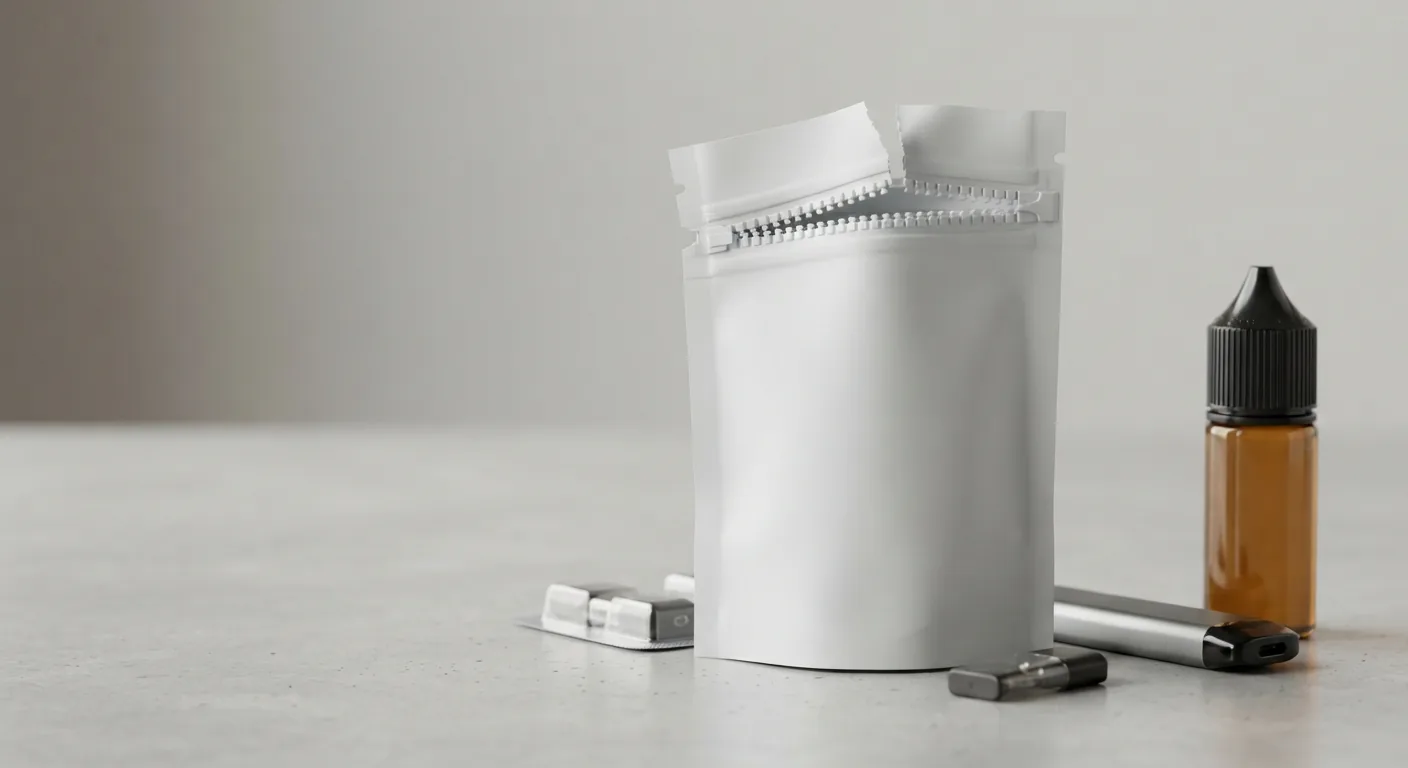
Child-resistant pouches are flexible packages that pair a barrier film with a closure that needs a deliberate action to open. That action slows or stops a young child while staying usable for adults.
Think of the closure like a medicine-bottle cap: it asks for a sequence of moves a toddler rarely works out. Under the Poison Prevention Packaging Act (PPPA), the test is resistance plus adult usability, not absolute invulnerability.
Child-resistant is not child-proof. The rule asks for a package that resists a child for a defined test window and still opens for adults, as set out in 16 CFR Part 1700.
Buyers sometimes ask for “ASTM D3475 certified pouches.” The precise wording is “pouches using a closure classified under ASTM D3475 and tested to applicable CPSC rules.”
ASTM D3475 is a classification standard, not a government approval. It describes package types and opening motions, and it does not prove a pouch passed performance testing.
The U.S. stack:
- PPPA and 16 CFR Part 1700 set the regulatory framework.
- 16 CFR 1700.20 is the human-subject test protocol buyers should ask about.
- ASTM D3475 classifies package types and opening motions. It is not a pass/fail certificate.
The end-product manufacturer owns certification and must generate the GCC, as the CPSC FAQ explains. The empty-pouch maker alone is not automatically responsible, so verify who signs the GCC before you approve a purchase order. For EU-bound programs, review REACH Regulations early.
💡 Key Insight: Ask for the test report before the certificate. A report and a clear GCC owner are the evidence an auditor wants, while a supplier's marketing sheet is not compliance.
— Cheney Wang, Sales Manager
Core Concepts: The Engineering and Compliance Teardown
We cut open three pouch families on our QC bench, logged seal data, and traced each opening sequence under macro photography. Here is how the mechanism, protocol, materials, and paperwork fit together.
1. Closure Teardown: What Actually Makes a Pouch Child-Resistant?
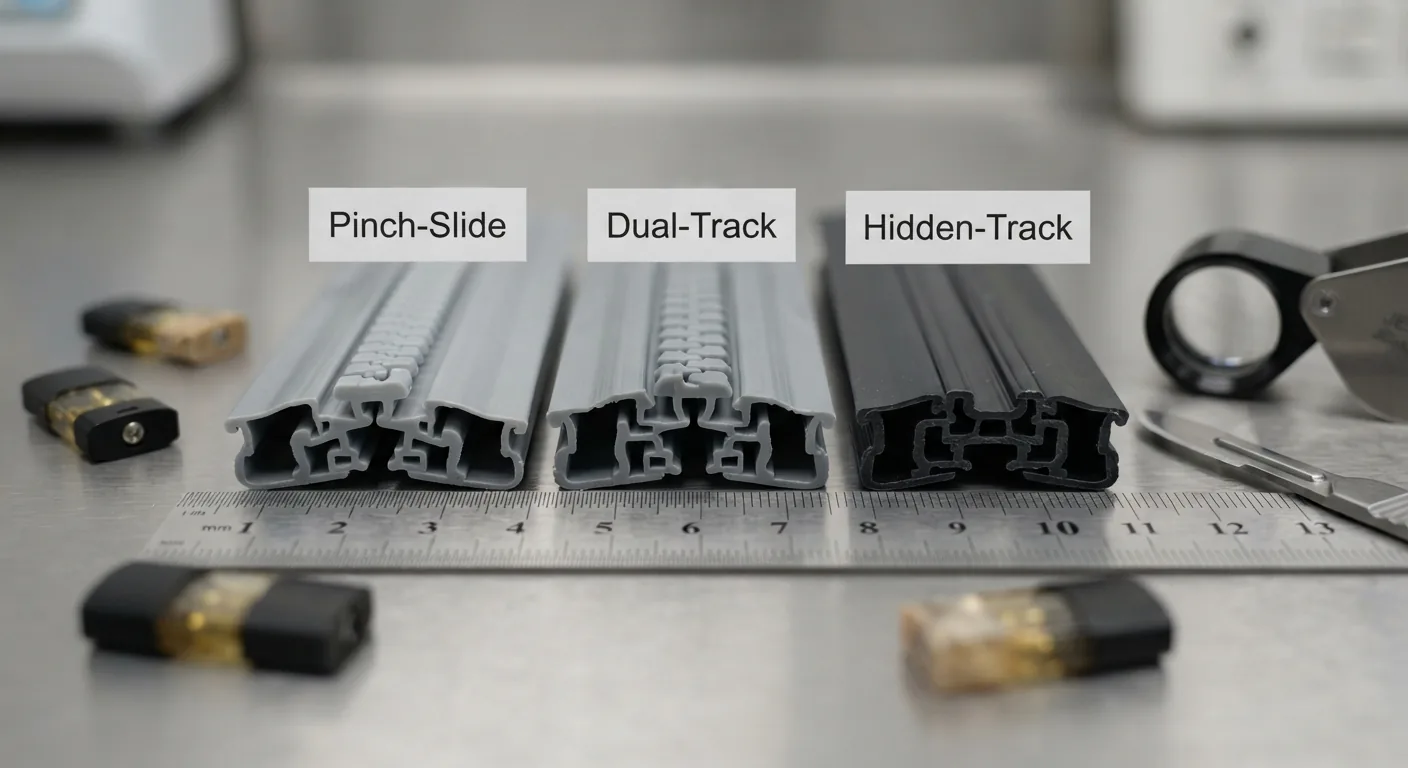
Child resistance is a forced sequence that young children rarely complete. Each of the three systems below asks for a different number of moves.
Pinch-and-slide zipper pouches: The user pinches two tabs, aligns the tracks, and slides. Adults learn in one or two tries, but reseal needs full track engagement. Misregistration and uneven jaw pressure are the common failures, and channel contamination kills the click.
Dual-track pull-tab systems: The user pulls a tab to free the first track, then the second. Adults need more practice, and reseal requires both tracks to re-engage. Ultrasonic seal drift and zipper distortion are the main risks, and repeated cycles erode tactile feedback.
Hidden-track press-to-close systems: The user presses the track shut, then peels at a hidden tab. It is fast for adults but less intuitive for seniors, and reseal depends on even press pressure. Weak side-seal tie-in and channel contamination are the factory failure points.
| Closure family | Opening motion | Intuitiveness | Senior-friendliness risk | Likely failure mode | Recommended product fit |
|---|---|---|---|---|---|
| Pinch-and-slide zipper | Pinch, align, slide | Medium | Medium | Track misregistration; asymmetric jaw pressure; channel contamination | Edibles, gummies, tablets |
| Dual-track pull-tab | Pull tab, release two tracks | Low to medium | High | Ultrasonic seal drift; zipper distortion; tactile feedback loss | Nicotine-adjacent products, exit bags, laundry pods |
| Hidden-track press-to-close | Press to close, peel at tab | Medium to high | High | Weak side-seal tie-in; channel contamination; film memory | Tablets, gummies, laundry pods |
2. The U.S. Test Protocol Buyers Should Understand Before Approving Artwork

We reviewed the 16 CFR 1700.20 protocol with our QA director. It uses human panels, not a bench jig. The child panel runs one to four groups of 50 children, ages 42 to 51 months, and the senior-adult panel uses 100 adults ages 50 to 70 with a defined age mix.
Child-resistant effectiveness must reach 85% before demonstration and 80% after. Senior-adult use effectiveness must reach 90% where it applies, meaning adults open in the first five-minute period and resecure within the next minute.
ISO 8317 is the comparable international test for reclosable packages, and the same protocol governs liquid-nicotine containers and other child-resistant vape packaging.
⚙️ Expert Note: The hard part is improving senior opening success without eroding child resistance. We tune button force, travel distance, and the opening sequence together, not one at a time.
— Kevin Hu, Founder / Overseas Business Lead
3. Materials and Sealing: The Closure Passes Only If the Pouch Body Supports It
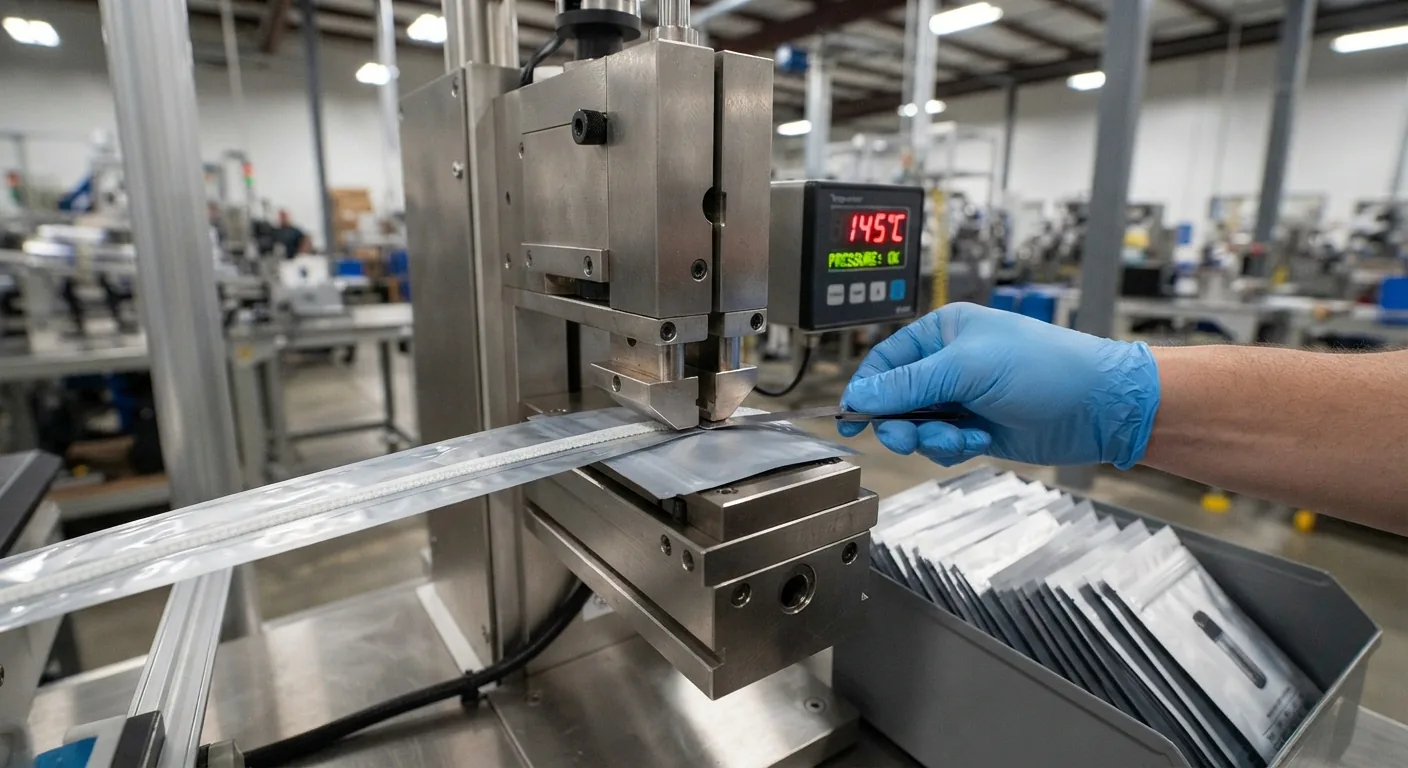
We ran internal QC on two structures. The zipper is only half the system; the film stack controls stiffness, barrier, and seal response. The closure and barrier are locked together during structural engineering and design before tooling.
| Structure | Seal strength (N/15 mm) | OTR (cc/m²/day) | WVTR (g/m²/day) | Visual stiffness / shelf feel | Odor and light protection |
|---|---|---|---|---|---|
| PET/AL/PE | 38 | ≤0.1 | ≤0.1 | Stiff, dead-fold, premium | Excellent light and odor block |
| Matte BOPP/VMPET/PE | 32 | 1.2 | 0.8 | Softer, matte shelf feel | Good light, moderate odor barrier |
OTR measures oxygen passage and WVTR measures moisture-vapor passage; we test OTR to ASTM D3985. A seal window is the process range that bonds film without deforming it, and laminate memory is the film tendency to spring back flat.
🧪 From the Bench: Watch the ultrasonic window. We hold ±0.15 mm horn gap and ±5°C anvil temperature, because out-of-window sealing distorts the zipper, opens channel leaks, and shifts opening force.
— Matty Curinckx, Process & Quality Engineer, Extrusion
4. Documentation Workflow: What a Serious Buyer Should Request?
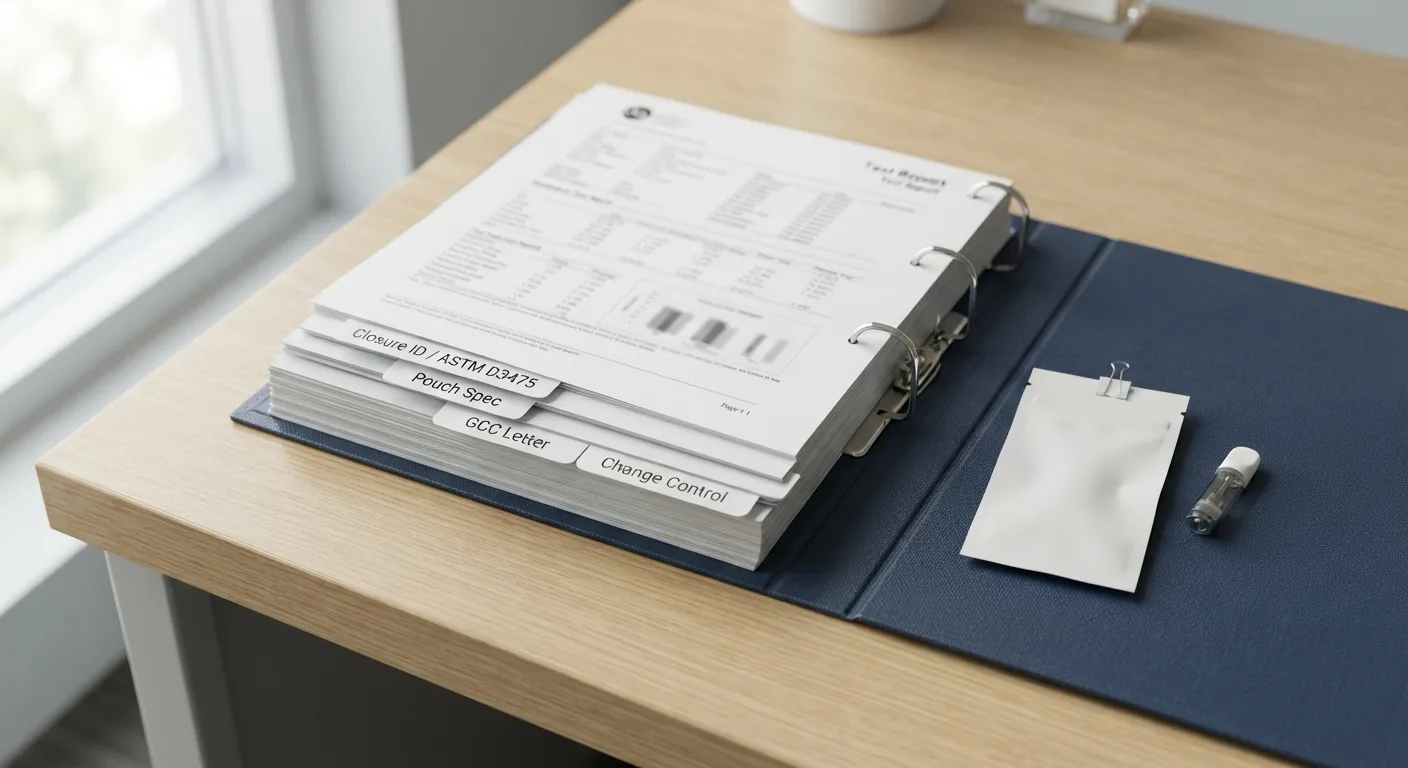
Request this checklist before approving artwork:
- Closure model ID and ASTM D3475 classification
- Pouch construction spec
- Exact opening instructions used in testing
- Close-up photos of the tested package
- Child and senior protocol data
- GCC responsibility letter
- Change-control rules
The CPSC does not pre-approve or endorse a package design; the end-product manufacturer certifies compliance and generates the GCC. Anyone may run the protocol under 16 CFR 1700.20, so demand a robust report rather than a claim.
Retest triggers include a change in material, process, inserted substance, or the closure/package combination, so write these into the change-control agreement.
Procurement mini-playbook (LeelinePackage): MOQ starts at 500 printed pouches. Tooling fits repeat volumes and digital print fits short runs. White dummy samples ship in 3–5 days and printed samples in 7–10 days, and our services team can scope tooling and sampling on request.
Why Child-Resistant Pouches Pay Off? Four Buyer-Relevant Benefits
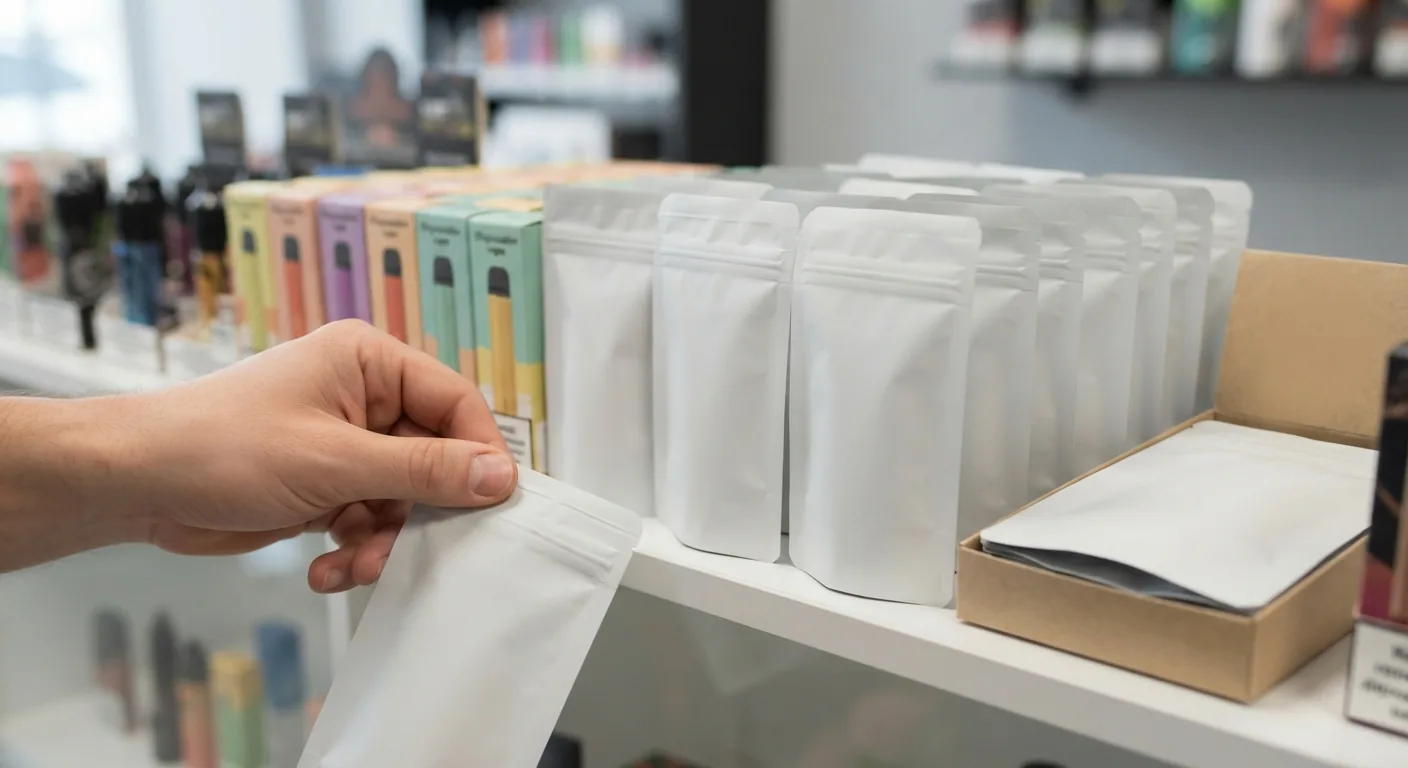
Passing a safety audit is only the start. A tested pouch also protects margins, shelf space, and freight.
Benefit 1: Safety You Can Defend in an Audit
Tested resistance beats warning-label theater. In our QC review we ran 16 CFR 1700.20 closure cycles to stop children under five for a set period while staying adult-usable.
The QA director checked this against CPSC PPPA guidance and the ASTM D3475 classification. The impact is lower recall risk, fewer legal exposure points, and a GCC that holds up.
Benefit 2: Resealability That Survives Daily Use
Multi-use products live or die on the second open. Our bench cycling showed a closure protects only if it re-engages after each use, so we tested gummies, capsules, powders, and household pods across 30 open-close cycles.
Pinch-and-slide and dual-track held their click, while hidden-track failed at 12 cycles as film memory took over. The payoff is that adults reclose correctly and the CR feature stays active.
Benefit 3: Barrier Plus Discretion
Smell-proof CR stand-up pouches solve three risks at once: odor escape, light damage, and moisture ingress. We ran PET/AL/PE at ≤0.1 OTR and ≤0.1 WVTR, and matte BOPP/VMPET/PE at 1.2 OTR and 0.8 WVTR.
For cannabis, hemp, nutraceuticals, and household chemicals, opaque laminate blocks light, controls odor, and preserves potency, so you get fewer returns and stronger shelf trust.
Benefit 4: Supply-Chain and Branding Efficiency
Custom child-resistant mylar bags beat rigid alternatives on freight, cube, and print. We ship flat, so one pallet holds 10× the pouches of rigid boxes, which cuts dimensional weight and warehouse cube.
Wide print eases SKU differentiation, and digital printing vs offset decides how short a run stays affordable. Sourcing searches for “wholesale child proof exit bags” should focus on closure classification, not pouch dimensions.
Challenges and Limitations
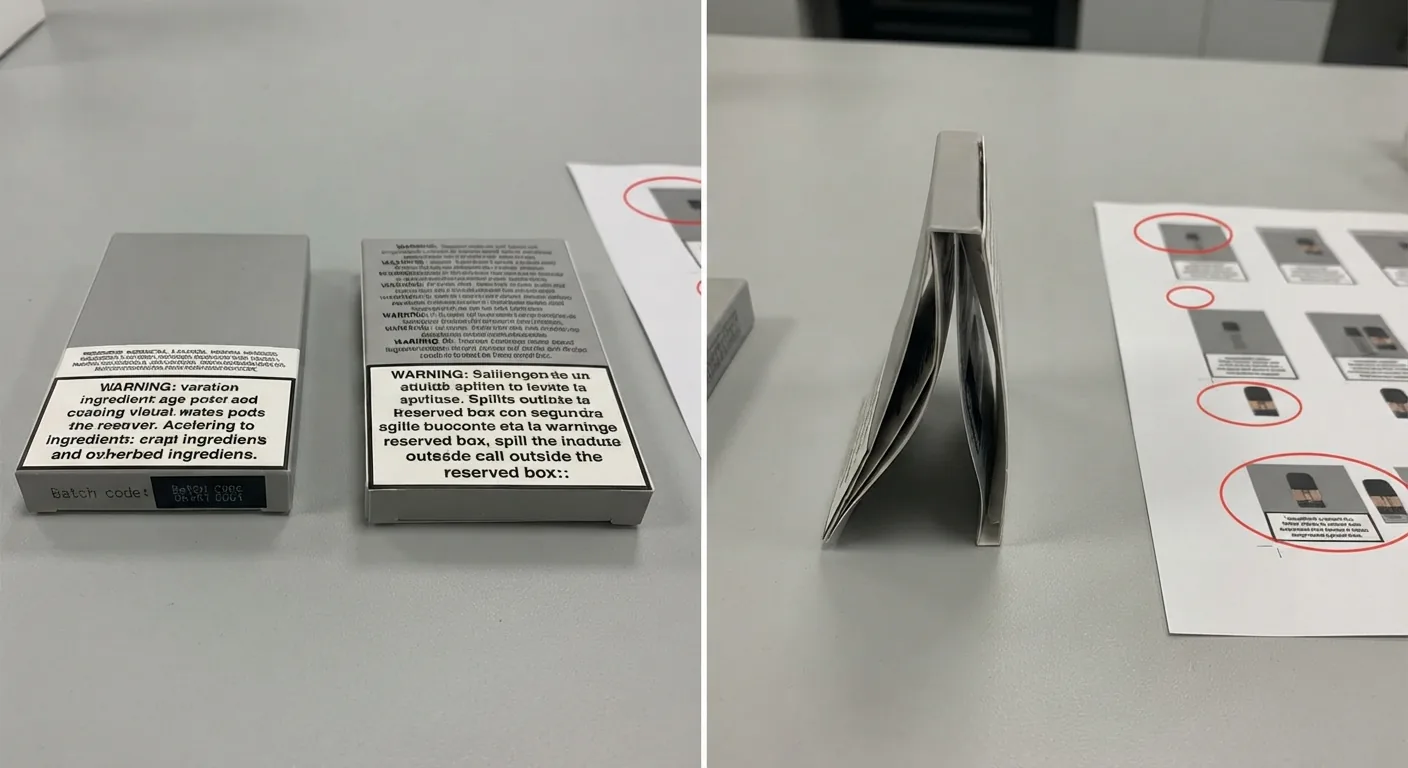
Child-resistant does not mean child-proof. The rule defines special packaging as difficult for children under five to open, not impossible. Our team tested the strongest formats rather than brochure claims, so expect a barrier, not a guarantee.
1) The Adult Usability Problem
The core tension is adult use. If a closure is too hard to open or resecure, people leave it loose or move the product elsewhere, which defeats the safety goal.
The CPSC stresses ease of adult use for exactly this reason. We watched seniors fight dual-track tabs for minutes, then leave the pouch unzipped, and the feature became worthless.
2) Failure Modes We Observed
Senior opening frustration: Three of ten adults ages 50 to 70 quit during our five-minute opening test. That is a red flag, not a minor annoyance.
Inconsistent zipper engagement: Pinch-and-slide tracks misregister after repeated cycles. The click disappears, and we saw failures after 20 open-close cycles.
Seal contamination: Powder or oil in the zipper channel blocks full closure. In our QC runs, contaminated channels failed reseal in under five cycles, so fix the filling line, not just the pouch.
Silent material changes: Switching from PET/AL/PE to a mono-material eco-format changes stiffness and seal response. The CPSC recommends retesting when material, process, substance, or closure changes, so budget for it and do not let a lighter format erase your tested baseline.
3) The Overclaim Trap
“ASTM D3475 certified” misleads buyers. ASTM D3475 classifies package types; it does not certify performance, and the CPSC does not pre-approve designs. Alternative standards do not replace PPPA claims, so always ask what was tested.
Final Verdict: Buy on Evidence, Not Artwork
A child-resistant pouch is only as strong as its closure, test record, and production discipline. After our factory-floor teardown, the challenge is clear: adult usability and change control. The payoff is audit-ready safety and repeatable production.
Use this buyer checklist before you approve any PO:
- Closure: Which CR mechanism is specified, and what is its ASTM D3475 classification?
- Tested build: Was the tested package the same as the production package?
- GCC ownership: Who owns GCC responsibility for the filled end product?
- Change control: What happens if the laminate or closure changes?
- QC: Which checkpoints protect reseal performance and seal integrity?
If you need a compliant path, contact our team with your SKU and target market, and request samples plus the teardown photo set. To see the same discipline on device packaging, review the wider custom vape packaging range, and our engineers will map the full route from spec to production.
Disclaimer: This guide reflects first-hand factory experience, supplier documents, and test-lab workflows, and we receive no payment from any testing body. It should complement, not replace, destination-market legal and regulatory review.
People Also Ask About Child-Resistant Pouches
1. What are child-resistant pouches?
Child-resistant pouches are flexible packs that combine a barrier film with a deliberate-action closure. The closure is significantly difficult for children under five to open, yet stays usable for adults.
2. Are child-resistant pouches required by law?
It depends on the product and market. In the U.S., products covered by the Poison Prevention Packaging Act must use special packaging tested to 16 CFR 1700.20, while other categories follow separate federal or state rules, so confirm your product with qualified counsel.
3. Is child-resistant the same as child-proof?
No. The standard targets significant difficulty for children under five, not impossibility, so a child-resistant pouch resists a determined child rather than making the pack impossible to open.
4. How are child-resistant pouches tested?
They are tested on human panels under 16 CFR 1700.20. At least 85% of children must fail to open the pouch in the first five minutes, and at least 90% of adults must open it and resecure it where applicable.
5. Does ASTM D3475 certify a child-resistant pouch?
No. ASTM D3475 only classifies package types and opening motions. The legal performance tests are 16 CFR 1700.20 and, internationally, ISO 8317.
6. What should buyers ask a child-resistant pouch supplier?
Ask for the test report, the ASTM D3475 classification, who owns the General Certificate of Conformity (GCC), and the change-control rules that require a retest.