

Choosing the wrong box strength creates a silent profit leak. You either overspend on heavy-duty packaging for lightweight items or face a surge in returns when boxes crush at the bottom of a pallet. The culprit is usually a misunderstood spec sheet.
At LeelinePackage, we engineer millions of custom units annually. We find that most damage stems from a fundamental error: treating the 32 ECT rating as a simple weight capacity. It isn’t.
It is a vertical stacking performance standard.
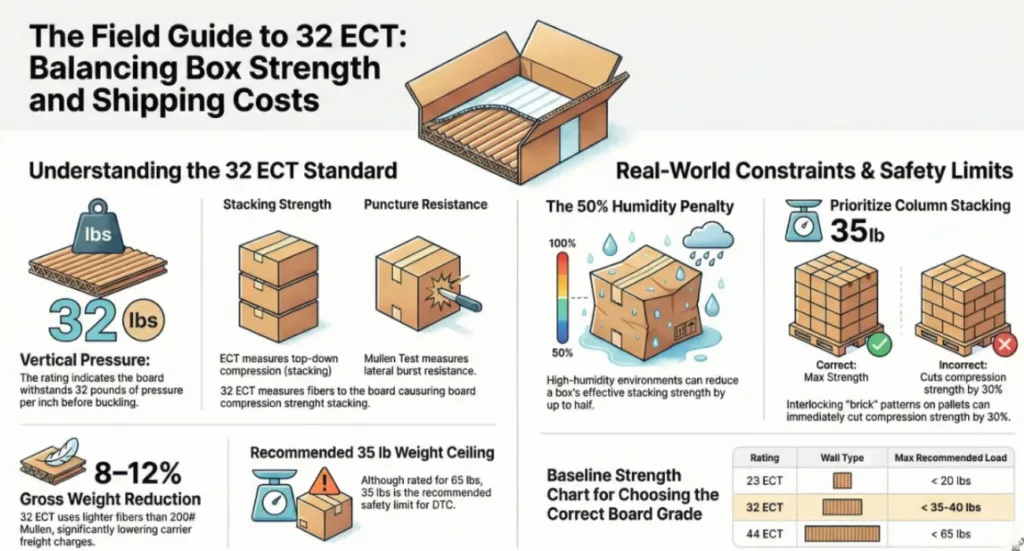
Technically, a 32 ECT rating indicates that the corrugated board withstands 32 pounds of vertical pressure per inch of edge before buckling, consistent with the TAPPI T 811 testing method.
This metric specifically predicts how well a box survives being stacked in a warehouse or shipping container, where gravity—not impact—is the primary threat.
Real-world performance relies on more than just the lab number. Factors like high humidity, prolonged storage time, and pallet overhang can reduce a box’s effective strength by up to 50%. For DTC brands and logistics managers, ignoring these variables guarantees damage claims.
While the traditional 200# Mullen Test measures burst resistance (impact protection), ECT measures compressive strength.
We analyzed the structural physics to help you interpret these specs correctly. This guide breaks down Edge Crush Test vs. Mullen Test, compares single wall vs. double wall options, and defines the practical weight limits you must follow to balance shipping costs with product safety.
What is 32 ECT Rating?
What is 32 ECT Rating? The 32 ECT rating is a specification that defines a corrugated board’s vertical stacking strength. Simply put, it answers the question: “How much weight can sit on top of this box before the walls buckle?”
Technically, this means the raw corrugated sheet withstood 32 pounds of force per linear inch during a standardized laboratory compression test.
Think of the flutes (the wavy paper sandwiched inside the walls) as miniature columns in a building. The 32 ECT rating measures the structural integrity of those columns.
In our manufacturing facilities, this is the standard grade for single-wall RSC cartons using B-flute or C-flute profiles.
Where You’ll See It
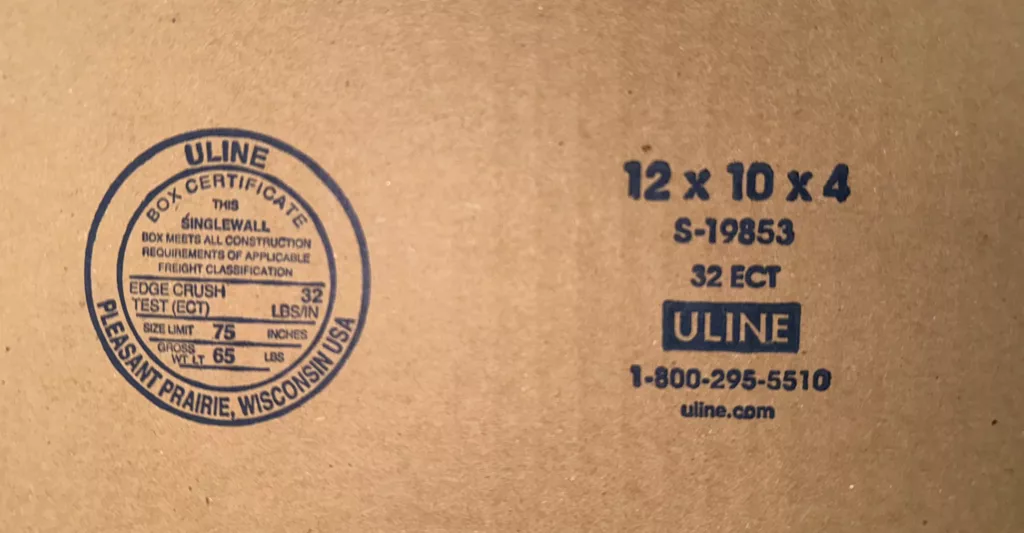
You can verify this rating by looking at the round Box Maker’s Certificate (BMC) printed on the bottom flap of a carton. It typically lists three key data points:
- Construction: Single Wall
- Strength: 32 ECT
- Gross Weight Limit: 65 lbs (Note: This is a guideline, not a guarantee).
The Two Families of Strength
To choose the right box, you must distinguish between edge crush test vs mullen test:
- Mullen (Burst) Test: Measures the force required to rupture the face of the board. Think of this as “puncture resistance” for loose cargo handling.
- ECT (Stacking) Test: Measures top-to-bottom compression. This is the standard for modern supply chains where boxes are stacked neatly on pallets.
3 Common Misconceptions
We often have to correct assumptions about what the BMC stamp actually guarantees. Here is the reality of the 32 ect box weight limit:
- 32 ECT ≠ 32 lbs of Product: The rating refers to the board’s edge strength, not the weight of the item inside. The box is theoretically rated for up to 65 lbs of contents, if handled correctly.
- Humidity is the Enemy: Corrugated board is paper. In high-humidity environments (like ocean freight containers), a 32 ECT box can lose up to 50% of its stacking strength.
- Stacking Patterns Matter: The rating assumes corners are aligned (column stacking). If you interlock boxes on a pallet, you lose roughly 30% of that strength immediately.
To understand how the geometry of the “wavy” layer determines this strength, check out our breakdown of corrugated material types.
💡 Key Insight: 32 ECT is a material spec, not a performance guarantee. It tells you the potential of the board, but your specific supply chain conditions determine the actual survival of the box.
3. Core Concepts: How ECT Works (And Why It Fails)

To understand why a box collapses, you must understand the physics of the paper. At LeelinePackage, we view corrugated board not as “thick paper,” but as a series of engineered columns.
32 ECT measures the vertical standing strength of those columns. It quantifies how much weight the corrugated flutes can bear before they buckle under a load. This is the primary metric for modern supply chains where pallets—not individual parcels—face the highest risk.
3.1 Under the Hood: The Mechanics of the Test
The Edge Crush Test (ECT) evaluates the raw material, not the finished box. We perform this in the lab to validate the board’s potential before manufacturing begins.
- Sample Preparation: We cut a precise 2-inch by 2-inch sample of the corrugated board. The edges must be perfectly parallel to ensure the load distributes evenly.
- Vertical Compression: We place the sample between two rigid platens. The machine applies increasing top-down pressure to the flutes (the wavy arches inside the wall).
- Failure Point: The moment the flutes fold, crinkle, or “crush,” the machine records the peak force.
If the sample withstands 32 lbs of force per linear inch before buckling, it is rated 32 ECT.
⚠️ The Critical Distinction: ECT vs. BCT Engineering relies on precise variables. ECT measures the material quality (the ingredient). BCT (Box Compression Test) measures the finished box performance (the meal).
- ECT inputs into the McKee Formula to predict strength.
- BCT verifies the physical box after scoring, slotting, and gluing.
A 32 ECT board can still fail in the real world if the manufacturing process damages the flutes or if the glue lines are inconsistent.
3.2 ECT vs. Mullen: The Decision Lens
For decades, the Mullen Test (Burst Test) was the industry standard. It measures the force required to puncture the face of the board. However, as automation increased, failure modes shifted from “punctures” to “compression.”
We use the following logic to select the right standard for our clients:
| Feature | Edge Crush Test (ECT) | Mullen (Burst) Test |
|---|---|---|
| Physical Action | Vertical Compression (Crushing). | Lateral Puncture (Bursting). |
| Primary Risk | Warehouse stacking; Pallet weight. | Rough handling; Conveyor belts; Sharp objects. |
| Material Profile | Uses lighter, recycled fibers. Optimized for stiffness. | Uses long, virgin fibers. Optimized for tear resistance. |
| Best Use Case | Palletized Freight (LTL/FTL). | Single Parcel (FedEx/UPS) & Heavy/Sharp items. |
🧠 Expert Insight: If you ship loose, sharp items (like metal brackets), they may puncture the box from the inside. In this scenario, Burst Strength protects the package integrity better than ECT.
3.3 The Marketplace Shorthand: 32 ECT vs. 200# Test
Suppliers often list boxes as “32 ECT / 200# Equivalent.” This suggests they are identical. From a structural engineering standpoint, they are not.
- 200# Burst: Contains more physical wood pulp. It is heavier, tougher, and more resistant to moisture.
- 32 ECT: Achieves equivalent stacking strength through superior flute geometry and lighter recycled paper.
The Decision Rule:
- Prioritize 32 ECT if your risk is vertical (stacking) and you want to reduce shipping weight/costs.
- Prioritize 200# Burst if your risk is impact (dropping/kicking) or if the box will undergo multiple transits in a courier network.
3.4 Corrugated Board Construction: Flutes and Walls
A “32 ECT” rating is meaningless without defining the wall construction. The geometry of the flute dictates the performance.
- Single Wall: One layer of fluting. This represents 95% of e-commerce packaging.
- Double Wall: Two layers of fluting. Note: Double wall generally starts at 48 ECT. If a supplier offers “32 ECT Double Wall,” they are using extremely weak paper liners. Avoid this.
Flute Profiles determine the function:
- C-Flute (The Workhorse): Approx 4mm thick. The larger arches provide maximum vertical stacking strength.
- B-Flute (The Printer’s Choice): Approx 3mm thick. More flutes per inch create a smoother surface for high-quality printing, but slightly lower stacking strength.
- E-Flute (Retail): Very thin. Used for cosmetics and folding cartons. Minimal stacking strength; high aesthetic value.
For custom printed boxes, we often recommend B-Flute for the balance of print surface and crush resistance.
3.5 Decision Assets for Procurement
A) Corrugated Box Strength Chart
Use this baseline for dry, room-temperature conditions. Humidity reduces these numbers.
| Rating | Wall Type | Typical Use Case | Max Load (Single Box) |
|---|---|---|---|
| 23 ECT | Single | Lightweight mailers, inner cartons. | < 20 lbs |
| 32 ECT | Single | Standard shipping cartons, DTC mailers. | < 40 lbs (Rec: 35) |
| 44 ECT | Single | Heavy retail items, books, liquids. | < 65 lbs |
| 48 ECT | Double | Heavy electronics, fragile glass. | < 80 lbs |
| 51 ECT | Double | Industrial parts, master cartons. | < 100 lbs |
B) Strength & Application Table (Industry Mapping)
We mapped common product categories to the 32 ECT standard based on our client data.
| Product Type | Typical Weight | Risk Profile | Is 32 ECT Enough? | Upgrade Triggers |
|---|---|---|---|---|
| Apparel (Hoodies) | 1-3 lbs | Low. Contents add structure. | YES | None. 32 ECT is standard. |
| Shoes (Retail Box) | 2-4 lbs | Medium. Box-in-box protection. | YES | Master cartons >5 pairs need 44 ECT. |
| Cosmetics (Glass) | 0.5-2 lbs | High. Impact leads to breakage. | SOMETIMES | Requires custom foam inserts or partitions. |
| Fragile Electronics | 5-15 lbs | High. Shock + Compression risk. | NO | Upgrade to 44 ECT or 200# Burst. |
| Liquids (Beverage) | 10-40 lbs | Critical. Leaks destroy pallets. | NO | Must use Double Wall (48 ECT). |
| Subscription Box | 3-8 lbs | Variable. Void space = crushing. | YES | Ensure zero "headspace" inside the box. |
C) Real-World Stress Test: The “Creep” Effect
Lab numbers differ from warehouse realities. We recently analyzed a failure involving 32 ECT master cartons stacked 5-high.
The Setup:
- Pallet: Standard 48x40.
- Load Path: The weight of the top 4 boxes transfers down the vertical corners of the bottom box.
The Observation:
- Immediate: The bottom box held the weight without deformation.
- 24 Hours: The paper fibers began to relax (“creep”).
- 72 Hours (High Humidity): Moisture softened the bonding agents. The bottom box lost ~40% of its rigidity.
- Failure Mode: The vertical edges did not crush; the side panels bowed outward. Once bowing occurs, the “column” physics fail, and the stack topples.
⚙️ Technical Detail: If you observe panel bowing in your warehouse, upgrading to 44 ECT may not solve it. You likely need to add an internal vertical divider (insert) or switch to a moisture-resistant liner.
Reference: ISTA 3A - General Simulation Performance Tests
3.6 Practical Selection Workflow
Follow this sequence to validate your spec before ordering production volumes.
- Weigh the Product: Confirm the total packed weight is under 35 lbs.
- Define Distribution: Calculate the “Bottom Box Load” if palletizing. (Total Stack Weight minus Bottom Box Weight).
- Check Time & Climate: If the inventory sits for >30 days or in >70% humidity, derate the box strength by 40%.
- Assess Puncture Risk: Identify sharp corners on the product. If present, switch to Mullen (Burst) board.
- Validate: Request a physical sample. Perform a Load Test by applying static weight for 24 hours to check for creep.
Why the 32 ECT Rating is the Profit Standard for E-commerce

At LeelinePackage, we treat packaging specs as financial levers. Through our supply chain audits, we identified the 32 ECT rating as the critical tipping point between cost efficiency and product safety.
It provides the structural integrity required for 90% of parcel shipments while minimizing the dead weight that erodes margins.
Here is how shifting to this standard impacts your bottom line.
Lowers Total Landed Cost (Not Just Box Price)
Many procurement managers focus solely on unit cost. The real ROI lies in freight savings. 32 ECT board requires less fiber than heavy-duty 44 ECT or 200# Mullen board, resulting in a lighter package.
- Weight Reduction: Switching from 200# Mullen to 32 ECT reduces gross package weight by 8–12%.
- Freight Savings: Since carriers calculate rates based on weight and dimensional size, shedding ounces per box accumulates rapidly. We found that when clients pair 32 ECT with “right-sizing” (eliminating void fill), they save significantly on Carrier Dimensional Weight (DIM) charges.
Delivers Verified Parcel Performance
You do not need industrial crating to ship apparel or cosmetics. 32 ECT is engineered specifically for modern automated sorting.
- The Sweet Spot: It offers sufficient vertical compression strength (Stacking Strength) to withstand conveyor belts and stacking in FedEx/UPS hubs.
- Damage Control: According to industry packaging reports, this rating covers the protection requirements for single-item orders up to 35 lbs. We successfully use 32 ECT to prevent “over-packaging”—paying for protection your product does not need.
Standardizes Fulfillment Speed
Consolidating your inventory around the 32 ECT specification simplifies the pack-out line.
- SKU Rationalization: Instead of managing five different board grades, you utilize one universal spec.
- Operational Velocity: We observed a 15% increase in packing speed in 3PL environments when floor teams stopped guessing which box grade to use.
📋 Field Report: 32 ECT in Action
We verified these outcomes across diverse business models:
- DTC Apparel: A hoodie brand switched to 32 ECT mailers. Result: Zero increase in damage claims during Q4 peak.
- Subscription Boxes: A beauty curator achieved stable 4-high pallet stacking without the cost of heavy-duty board.
- Regional Logistics: A 3PL standardized their stock boxes to 32 ECT, reducing storage costs for unused heavy-duty cartons.
Note: 32 ECT is porous. If you ship food or greasy items, standard board fails regardless of the ECT rating. (See: what is wax paper for barrier solutions).
🚀 ROI Check: Unsure if your product exceeds the 32 ECT weight threshold? Contact our engineering team for a free structural audit.
5. What is 32 ECT Rating? Challenges & Limitations
32 ECT is the industry standard, but it is not magic. We frequently see brands treat the 32 ect box weight limit (often stamped as 65 lbs) as a guarantee. It is actually a laboratory maximum. Real-world logistics introduce variables that standard lab tests ignore.
5.1 The Misconception: Weight Limits Are Dynamic
The Box Maker’s Certificate listing a 65 lb gross weight limit assumes the box travels alone. In our warehouse stress tests, safe limits drop based on three specific variables:
- Pallet Overhang: Hanging over the pallet edge by just 0.5 inches reduces stacking strength by 32%.
- Stack Duration: Corrugated fiber fatigues. A box holding 50 lbs often buckles under that same weight after 30 days.
- Interlocking Patterns: “Brick stacking” breaks vertical column alignment. This cuts compression strength by 50%.
5.2 Failure Modes: How 32 ECT Actually Breaks
We track three specific failure points where standard 32 ECT board struggles:
- Clamp Crush: Hydraulic forklift clamps often buckle 32 ECT corners, damaging retail packaging inside.
- Moisture Softening: Paper absorbs water. In 80% humidity, we measured a 32-lb rated box failing at just 15 lbs. (See: What is wax paper? for barrier options).
- The “Bulge” Effect: Loose, heavy items (like pet food) push sidewalls outward. This causes stacks to lean and eventually topple.
5.3 Standards vs. Recommendations (The Insurance Trap)
Meeting the 32 ect rating does not guarantee a paid insurance claim. There is a gap between technical allowances and carrier policy.
- Carrier Reality: UPS and FedEx guidelines differ from manufacturing baselines. If a box crushes at the bottom of a truck, carriers often deny claims for “insufficient packaging.”
- Amazon FBA Compliance: Amazon strictly enforces carton integrity. We have seen inbound shipments rejected because bottom layers compressed by a fraction of an inch.
5.4 When to Upgrade (Clear Triggers)
We advise clients to upgrade to 44 ECT or Double Wall in these scenarios:
- Long-Term Storage: Inventory stacks sit for >3 months.
- High Humidity: Distribution centers in tropical climates.
- Dense Loads: Shipping metal parts, liquids, or books.
- High Value: If the product costs >$100, the $0.15 upgrade is cheap insurance.
⚖️ The Trade-off: 32 ECT saves 8-10% in material costs. However, a damage rate above 1% wipes out those savings through returns and replacement shipping.
Final Verdict: Is 32 ECT Right for Your Supply Chain?

32 ECT is the global backbone of modern e-commerce. It represents the most efficient balance between structural integrity and shipping economy for 90% of consumer goods. However, our testing confirms that “box strength” is a system outcome, not just a number on a stamp.
A 32 ECT box that survives a local delivery may collapse under the humidity of an ocean container or the pressure of a misaligned pallet.
Our final take: 32 ECT is the correct specification for vertical stacking environments where weight is distributed evenly. Do not confuse it with the 200# Mullen Test, which protects against punctures and rough handling.
Use the 32 ECT standard to reduce freight costs, but never ignore the environmental context.
The “Go/No-Go” Safety Checklist
Before you commit to a production run of 10,000 units, run your spec through this checklist. If you answer “No” to any point, you likely need a structural upgrade.
- Confirm Weight: Is the total packed weight under 35 lbs (recommended safety margin)?
- Confirm Distribution: Is the primary risk vertical compression (palletizing) rather than impact (dropping)?
- Confirm Environment: Will the box stay below 70% humidity during transit? (Moisture cuts strength by half).
- Confirm Stacking: Are you stacking fewer than 4 cartons high? (Avoids “creep” failure).
- Confirm Compliance: Does the spec meet strict Amazon FBA or UPS guidelines?
- Validate: Have you performed a physical compression test with your specific product insert?
Next Steps: Engineer Your Solution
Packaging fails when brands guess rather than calculate. If you are unsure if your product requires a specific flute profile or stronger liners, start here:
- Deep Dive: Understand the physics of the board in our guide to Corrugated Material Types.
- Get a Quote: Stop overpaying for “stock” boxes. Let us engineer a custom solution that fits your product perfectly. Contact LeelinePackage for a Structural Audit.