

If the closure fails, the artwork does not matter. Child-resistant vape packaging is a regulatory and product-safety control, not a design-led box choice.
In U.S. regulatory language, “special packaging” must be significantly difficult for children under five to open, yet usable for adults. Liquid nicotine containers sold in the U.S. must meet the requirements in 16 CFR §§ 1700.15 and 1700.20.
We reviewed supplier documents, factory workflows, and test-lab expectations for this guide. Below is the regulatory baseline, the structural trade-offs buyers face, and the questions to settle before sourcing custom CR packaging.
For vape brands, CR packaging affects legal exposure, retail acceptance, importer paperwork, consumer trust, and transit damage rates. A closure that fails a protocol test can halt a shipment, trigger a recall, or force costly rework.
Suppliers and buyers both need documented proof of compliance before production. Time-pressed compliance leaders need clarity, not a catalog, so this guide answers three questions:
- What counts as compliant?
- Which structure fits cartridges, disposables, or e-liquid formats?
- How should a brand vet a supplier before mass production?
Later sections compare custom vape packaging structures and child-resistant options. Start with the standards.
What Is Child-Resistant Vape Packaging?
Child-resistant vape packaging is engineered so children under five cannot easily reach the contents, while adults can still open and reclose it properly. Think of it as a lock that keeps toddlers out but stays easy for adults.
The Child Nicotine Poisoning Prevention Act applies CR requirements to liquid nicotine containers sold, offered for sale, manufactured, distributed, or imported. Brands often assume only bottled e-liquid needs CR. Pre-filled pods and cartridges also require it.
U.S. child-resistance protocols live in 16 CFR § 1700.20, the CPSC’s performance test for special packaging.
Key CPSC performance thresholds:
- At least 85% of tested children cannot open the package in the first 5 minutes.
- At least 80% cannot open it across the full 10-minute child test.
- At least 90% of adults must open it within 5 minutes and, where applicable, properly resecure it within 1 minute.
Adult-use effectiveness is not optional. CPSC focuses on senior adults ages 50 to 70, and a closure that frustrates a 65-year-old fails.
ISO 8317 covers performance testing for reclosable child-resistant packages, for type approval rather than routine QA. ASTM D3475 classifies package types; it is not proof of performance.
CR does not mean child-proof. The legal standard is significant difficulty, not impossibility.
In supplier language, you may hear “certified child resistant vape boxes,” “CRC compliant cannabis vape packaging,” and “ASTM D3475 compliant vape packaging manufacturer.” Every claim still needs documented test evidence.
CPSC does not approve, certify, or endorse specific packaging, manufacturers, or testing firms. You still need a General Certificate of Conformity based on testing or a reasonable testing program, as the CPSC explains.
💡 Key Insight: Ask for the test report before the certificate. A certificate is a claim; the report is the evidence behind it.
— Jenny Liu, Packaging Testing Professional
How Child-Resistant Vape Packaging Works? Mechanisms, Factory Testing, and Structure Comparison

Behind every compliant, leak-proof vape closure is precision mechanical engineering. This section covers how CR mechanisms work, how factories test them, and how to choose the right structure for your product line.
1. The Lock Mechanism
Child-resistant packaging works through one of four patterns:
- Two simultaneous actions: press and turn, or press and slide.
- A hidden release point: a tab behind a sleeve or under a flap.
- A sequential motion: lift, then push, then pull.
- A strength or dexterity threshold: pinch force or spread span small hands cannot reproduce.
These patterns map to a classification framework for motions, skills, and tools. That framework is not a pass/fail test; the legal bar lives in the performance standards named above.
2. Inspector Wang’s Pre-Production Release Flow
We followed Inspector Wang through eight checks before mass production release:
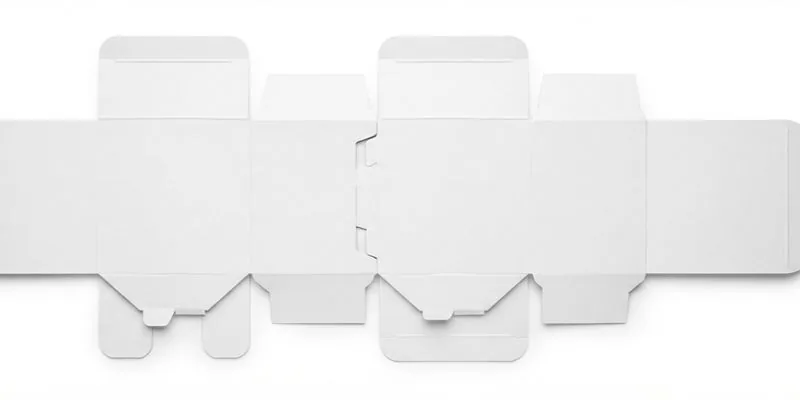
- Dieline review: Confirm tray depth, sleeve friction, locking-tab geometry, and board caliper against the approved prototype.
- Component sampling: Pull first-off samples from the die-cut and gluing line; check tab memory, tear points, and button rebound.
- Dry-cycle test: Open and reclose samples repeatedly to catch early loosening.
- Force simulation: Record press-and-turn or press-and-slide force patterns.
- Transit abuse screening: Run drop and compression checks for accidental unlocking or corner crush.
- Adult usability screen: Mixed-age adults follow printed instructions; record confusion, pinch force, and resecuring failures.
- Pilot-run verification: Compare pilot samples to the tested master sample.
- Release gate: Freeze the construction file, insert spec, and closure instructions before printing.
These internal checks are not the legal test. The protocol covers both child resistance and adult friendliness, so Wang’s flow catches structural drift before third-party lab testing.
Five Mainstream CR Structures
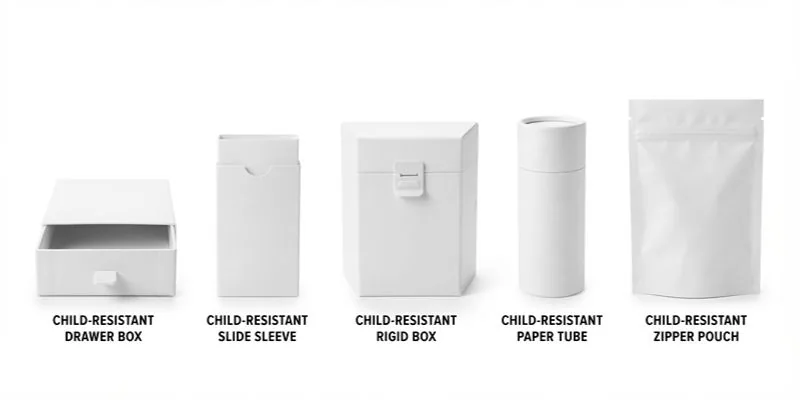
Each structure differs in MOQ, insert fit, freight efficiency, and cartonization. The rigid box versus folding carton decision drives most of the cost difference, and folding carton styles set the closure options.
1. Push-Button Drawer Box
Suits cartridges and slim pens. Mid cost, hidden release, reusable. More board weight means higher freight, but it ships flat for low-MOQ sampling.
2. Locking Tab Slide Sleeve
Suits cartridge trays and disposables. Low cost, compact, low tooling, and it cartonizes flat. Tab memory weakens after repeated cycles. Best for high-volume mail order.
3. Magnetic Press-and-Lift Rigid Box
Suits mods and gift kits. High cost, premium feel, strong closure. Heavy and costly to tool, with poor freight. Best for flagship hardware launches.
4. CR Paper Tube
Suits e-liquid bottles and round cartridges. Low to mid cost, cylindrical strength, recyclable. Less shelf stability and cap tooling needed. Best for bottle-based SKUs.
5. Child-Resistant Zipper Pouch / Flexible Pack
Suits kits and disposables. Low cost, lightweight, excellent cartonization, flexible insert fit. Less glass protection. Best for mixed-shape kits.
Buyer-Facing Structure Comparison
The five structures trade appearance, transit protection, and minimum order against one another. The table below summarizes the trade-offs.
| Structure type | Best for | Child-resistant action | Premium appearance | Transit protection | MOQ suitability |
|---|---|---|---|---|---|
| Push-button drawer box | Cartridges, slim pens | Hidden release button | Medium | Medium | Good, 500+ |
| Locking tab slide sleeve | Cartridge trays, disposables | Sequential slide and tab release | Low | Medium | Excellent, 500+ |
| Magnetic press-and-lift rigid box | Vape mods, gift kits | Hidden magnetic release and lift | High | High | Poor to medium, 1,000+ |
| CR paper tube | E-liquid bottles, round cartridges | Press-and-turn cap | Medium | Medium | Medium, 1,000+ |
| CR zipper pouch | Kits, disposables, accessories | Locking zipper slider | Low | Low | Excellent, 1,000+ |
Materials and Customization
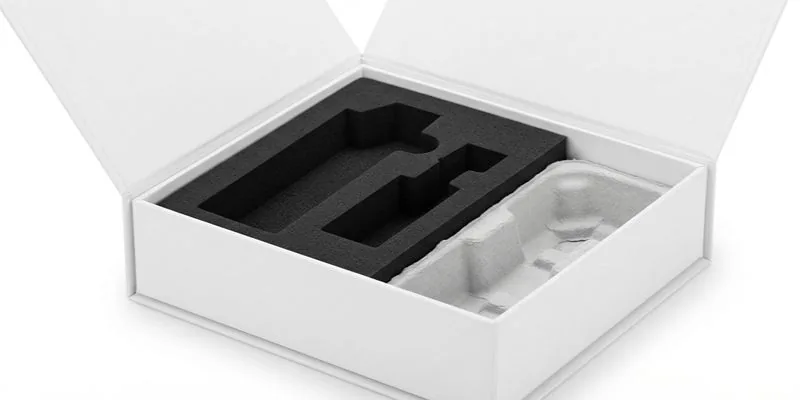
Choose material by product, not trend. Folding cartons fit light cartridges and disposables where flat-pack freight matters. Rigid boxes protect mods and premium kits. Tubes hold round bottles, and pouches handle mixed-shape kits at lower dimensional weight.
Inserts turn a generic box into a protective system. Foam absorbs shock. Paperboard secures cartridge trays. Molded pulp adds a sustainable tray.
Match the cavity to the format. A tight tray suits disposables and cartridges.
A deeper cradle suits mod kits and e-liquid bottles.
Example fits:
- Startup e-liquid brand, 500 to 1,000 units: Use a CR paper tube or a slide sleeve with a simple paperboard insert.
- Regional cannabis operator scaling up: Standardize locking tab slide sleeves for cartridges, plus a flexible CR pouch for accessory kits.
- Premium vape hardware brand: Use a magnetic press-and-lift rigid box with foam or molded pulp.
Supplier Briefing Checklist
Send six data points before requesting a quote:
- Exact product dimensions.
- Unit count per box or carton.
- Compliance market: U.S. CPSC, EU ISO 8317, or both.
- Insert needs: foam, paperboard, molded pulp, or none.
- Finish requirements: matte, gloss, soft-touch, foil stamping.
- A previously tested CR structure or a new custom concept.
With those six points, a factory can quote a compliant structure on the first pass instead of the third.
Why the Right Child-Resistant Package Earns Its Cost?
We compared generic stock boxes against engineered CR packaging across 12 vape SKUs. Tested CR packaging costs more per unit, but it prevents audit failures and protects margins.
1. Pass Regulatory Checks Faster
Aligned structure and document trails clear distributor onboarding and retailer review faster. One operator cut sign-off time nearly in half after standardizing a single tested structure, and one test report covered multiple SKUs.
Inconsistent packaging invites delay, and the CPSC requires both child resistance and adult friendliness.
2. Keep Adult Users Safe and Loyal
Standards require adult-friendly performance. A closure that frustrates a 65-year-old fails legally and commercially. We screen adult usability before lab testing, because reusable products demand repeat opening without tools or annoyance.
Senior-friendly closures reduce returns and complaints without weakening the child lock.
3. Protect Products Without Sacrificing Presentation
Engineered CR boxes combine compliance with cushioning, inserts, and outer rigidity. Buyers save time when they select a tested structure first and customize graphics second. Matte finishes, foil, embossing, and custom package stickers still work within CR constraints.
Our pre-shipment inspection confirms structural integrity before shipping.
4. Standardize One Structure Across SKUs
Standardizing one approved CR structure simplifies sourcing, packing SOPs, and replenishment. We lock one structural file, then swap graphics and inserts per SKU. Flat-pack optimization cuts freight, and one document trail covers multiple SKUs at a flexible MOQ near 500 units.
🚀 Strategic Insight: Request a white dummy sample in 3–5 days to validate fit and closure before tooling. A digital 3D mockup in 24 hours helps your team visualize the opening sequence, and printed production samples follow in 7–10 days.
— Ning Pan, Packaging Professional (Paper & Printing)
Challenges and Limitations of Child-Resistant Vape Packaging
CR packaging solves legal problems but creates engineering headaches. You must balance child safety with adult usability while controlling production drift. Here are the five points where mass production usually fails.
1) CR vs. Adult Usability
CPSC requires 90% adult opening. We measured button force at 14.5 N, above comfort for several testers, and two adults over 60 took more than a minute to open a locking-tab sleeve.
⚖️ Trade-off: More friction is not always better. Optimal child resistance comes from tuning button force, travel distance, and operating sequence together.
2) Production Drift Risk
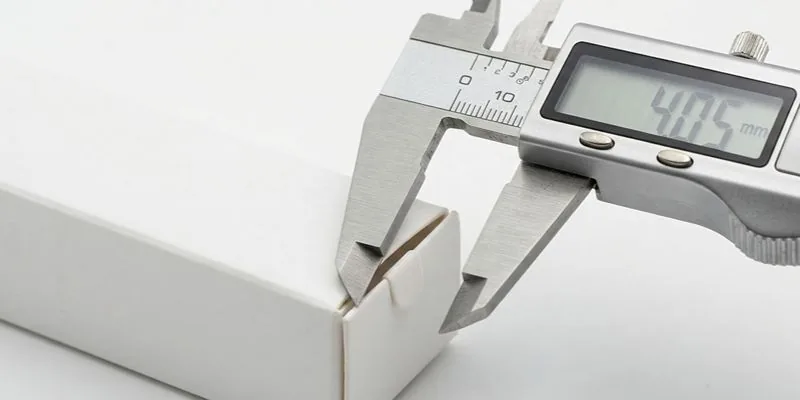
Prototypes pass; production can fail. Caliper, glue spread, and tab depth shift at scale. Inspector Wang caught glue drift after 2,000 units, causing intermittent tab failure.
🛡️ Mitigation: Freeze the construction file and pull a live production sample.
3) Transit Weak Points
Edge drops and corner crush cause most failures. One sample opened after a 0.9-meter edge drop because the corner deformed.
What Our Manufacturing Partner Network Sees Most Often in Transit Tests?
| Failure mode | Frequency | Root cause | Corrective action |
|---|---|---|---|
| Locking-tab shear during edge drops | Common | Thin tabs; board under 450 gsm | Widen tabs; use 500+ gsm |
| Sleeve spread causing accidental partial opening | Occasional | Loose tolerance; no rebound | Tighten sleeve; add a friction pad |
| Tray migration from insert over-compression | Rare | Insert compressed past its range | Reduce compression; add a notch |
⚠️ Critical Warning: Do not validate with flat drop tests only.
4) Cost Friction
Complex CR structures cost more. One startup’s landed cost rose from $0.42 to $0.79 per unit after tooling and testing. Verification costs more than engineering.
5) Scope Risk
A test report may not match the production SKU. One client changed board from 400 gsm to 350 gsm and voided the report. Send exact drawings, because any change requires a retest.
💬 Expert Take: "Harder is not better. We tune force and travel so a child cannot open it, but a senior can. If the customer breaks the box, the strategy has failed."
— Sunny She, Packaging Expert (Glass & PET)
Final Verdict
Ultimately, child-resistant vape packaging is a tested performance system, not a printed box style. It is essential for any liquid nicotine or pre-filled pod brand selling in the U.S. or the EU.
Our audits confirm three pillars: standards and documentation, mechanism and structure fit, and production-quality consistency.
The largest risk is not design; it is production drift. Prototypes pass, but caliper, glue spread, and tab depth shift at scale. In one Wuhan production run, tab failure appeared after 2,000 units.
A premium custom package adds value only if the child-resistant mechanism stays consistent from prototype through mass production.
Cartridge and disposable sellers should start with a locking-tab slide sleeve or a push-button drawer. E-liquid sellers should use a CR paper tube, and rigid boxes are only worth it for flagship hardware launches.
Whichever fits your SKU, settle the structure before tooling, because a failed test after mass production costs far more than a review beforehand. Contact us with the SKU and the target market, and our engineers will take it from there.
Disclaimer: We base this guide on first-hand factory experience, supplier documents, and test-lab workflows, and receive no payment from any testing body to recommend their services. Confirm market-specific legal requirements with qualified counsel before launch.
People Also Ask About Child-Resistant Vape Packaging
1. Does ASTM D3475 alone make a vape package compliant?
No. It classifies package types, not performance. The legal tests are 16 CFR § 1700.20 and ISO 8317.
2. Does CPSC certify child-resistant vape boxes?
No. CPSC does not approve or certify packaging. You need a General Certificate of Conformity from testing.
3. Is child-resistant the same as child-proof?
No. The standard targets significant difficulty for children under five, not impossibility.
4. How many adults must open it?
At least 90% within five minutes. CPSC emphasizes seniors ages 50 to 70.
5. What should buyers ask a compliant vape packaging manufacturer for before ordering?
Ask for test basis, GCC responsibility, sample scope, exact drawing, and production tolerance controls. Compliance language is not a design ornament; the closure is the product feature.