

E-commerce brands lose millions annually to damaged goods and inefficient shipping volume. The tension is obvious. Packaging engineers and procurement teams need maximum protection per gram to survive aggressive courier networks.
Meanwhile, direct-to-consumer founders demand a flawless, high-end unboxing experience that encourages customer loyalty and social media sharing.
Having engineered thousands of custom shipping solutions at LeelinePackage, I watch brands make the same costly mistake every day.
They either select a gorgeous folding carton that crushes during transit, or they default to heavy corrugated board that inflates freight budgets and ruins the premium feel.
Micro flute packaging bridges this exact gap. It is a highly compressed, ultra-thin corrugated board that delivers the structural durability of a shipping box alongside the smooth printing surface of a luxury retail carton.
We consider it a design-forward structural material, not just a prettier piece of cardboard.
This guide explains exactly what micro flute corrugated is, how the mechanics work, and the specific performance differences between E-flute, F-flute, and N-flute profiles.
You will learn exactly when this specific format outperforms standard cartons or thicker corrugated alternatives. We evaluate these materials against the practical criteria that actually impact your unit economics:
- High-fidelity print quality and finish options
- Structural crush resistance (ensuring compliance with ISTA transit testing standards)
- Material sustainability and overall recyclability
- Landed cost and dimensional weight reduction
Here is exactly how the underlying structure functions.
What is Micro Flute Packaging?

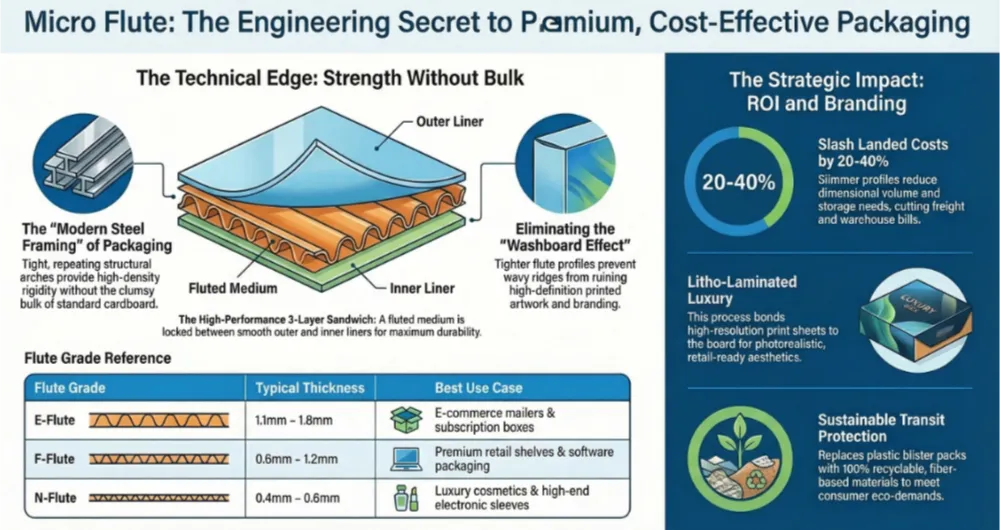
Micro flute packaging is a category of fine-flute corrugated boards featuring much thinner, tighter wavy profiles than standard shipping cardboard.
Think of standard shipping boxes like heavy wooden scaffolding. They offer massive protection but consume excess space. Micro flute acts like modern steel framing. It provides high-density, rigid protection without the clumsy bulk, significantly reducing your volumetric shipping weight.
On our factory floor, we build every micro flute board using a precise three-layer sandwich:
- Outer liner: The smooth exterior paper surface that acts as your primary printing canvas.
- Fluted medium: The tightly packed wavy paper arch that creates structural crush resistance.
- Inner liner: The smooth interior layer that locks the wavy medium firmly in place.
The packaging industry categorizes these boards into common grades like E, F, G, and N. However, our structural engineers prioritize E, F, and N flutes. These specific profiles work best for premium retail and lightweight e-commerce shipping applications.
This material bridges a massive gap in sustainable retail packaging. If you currently use eco-friendly folding cartons, micro flute delivers superior structure and internal cushioning for fragile goods. It feels slightly thicker and much more structurally engineered.
Conversely, compare it to traditional B or C flute shipping boxes. Micro flute is significantly slimmer, smoother, and lighter. This smooth surface makes it the top choice for high-definition print packaging.
The tight flutes prevent the ugly “washboard” effect where wavy lines ruin your printed artwork during the lamination process.
Keep in mind that a thinner board is not automatically stronger for every heavy-duty application. You can see exactly how these profiles differ in our E-flute vs. B-flute structural breakdown.
Because it perfectly balances aesthetic appeal with transit safety, we consistently engineer micro flute for:
- Cosmetics kits
- Electronics accessories
- Subscription mailers
- Promotional sets
- Premium inserts and sleeves
A common packaging myth assumes the flute letter alone dictates box strength. In practice, professionals define performance differently.
As outlined in the corrugated testing standards by the Fibre Box Association, the exact board combination and specific paper liner weights ultimately determine your packaging’s true structural integrity.
For example, a high-density N-flute combined with a heavy Kraft liner often outperforms a poorly constructed B-flute box.
💡 Key Insight: Micro flute gives brands the protective strength of a shipping box with the premium print quality of a luxury retail carton.
When buyers compare micro flute packaging, they actually evaluate four variables: geometry, linerboard, printing method, and test performance. On the factory floor, we treat these boxes as engineered structural systems.
You cannot change one element without altering the entire performance profile.
1) The Engineering Logic Behind Micro Flute
To understand board behavior, examine the physical geometry of the fluted medium. Think of the wavy inner layer as a series of repeating structural arches.
When we shrink these arches and pack them tighter together, we fundamentally change how the board reacts to stress. First, a tighter flute profile creates a smoother print surface. The outer paper spans a shorter distance between each arch, preventing it from sagging.
This eliminates the “washboard” effect seen on standard shipping boxes.
Second, this compressed geometry results in a lower caliper (thickness). You get a lighter pack profile, allowing you to stack more boxes onto a shipping pallet and cut dimensional weight costs.
However, this alters your cushioning and stacking tradeoffs. Less air between the paper layers means the board absorbs less impact shock. We always warn our clients that highly compact flute structures drastically improve visual appearance and conversion efficiency.
But they do not automatically guarantee superior crush performance. You must pair the right geometry with the exact paper weight.
2) Technical Comparison: E, F, and N Flutes
When our engineers evaluate e-flute vs f-flute corrugated or map out N-flute specifications, we rely on typical market ranges. These thicknesses vary slightly depending on the specific liner combination and the converter’s equipment.
| Flute Grade | Typical Caliper (mm) | Typical Caliper (microns) | Approx. Flutes per Linear Foot | Print Surface Quality | Typical Use Cases | Main Tradeoff / Caution |
|---|---|---|---|---|---|---|
| E-Flute | 1.1 mm to 1.8 mm | 1100 to 1800 µm | 90 to 96 | Excellent | Cosmetics, e-commerce mailers, retail boxes | Adds slight bulk compared to folding cartons. |
| F-Flute | 0.6 mm to 1.2 mm | 600 to 1200 µm | 124 to 128 | Superior | Premium retail, fast-food clamshells, software | Provides less impact cushioning than E-flute. |
| N-Flute | 0.4 mm to 0.6 mm | 400 to 600 µm | 160 to 170 | Flawless | Luxury cosmetics, high-end electronics sleeves | Features low edge-crush strength for heavy transit. |
3) Interpreting the Specs for Buyers
Data only matters when applied to a specific product. Here is how we interpret this table for our brand partners.
E-flute acts as the ultimate all-rounder. We use it constantly for branded mailers, cosmetics cartons, and e-commerce gift boxes. F-flute sits a tier thinner. It looks incredibly clean and crisp.
We recommend it for premium retail environments where shelf appearance and compactness matter more than heavy-duty shipping strength. N-flute feels almost identical to thick cardstock but hides a microscopic wavy core.
Brands select it for pure visual finesse, never for heavy transit strength.
Practical Recommendations by Segment:
- Electronics accessories: Use F-flute to keep retail boxes compact and precise.
- Skincare/cosmetics kits: Use E-flute for subscription boxes, or N-flute for lightweight shelf cartons.
- Subscription or D2C mailers: Stick to E-flute to ensure the box survives the courier network.
- Retail-ready presentation packs: Use F-flute to maximize the number of units you can fit on a retail shelf.
4) Printing and Converting: Why Micro Flute Looks So Good
We print on a corrugated board using several distinct methods. Direct print applies ink straight to the raw board. Digital print sprays ink like a desktop printer. Flexographic print uses rubber plates to stamp simple graphics.
When we need flawless, retail-ready aesthetics, we upgrade to litho-laminated microflute. This process perfectly supports high-definition print packaging by completely separating the printing step from the corrugated board creation.
Here is the litho-lamination sequence:
- Print: The press prints your high-resolution artwork onto a flat, premium sheet of coated paper.
- Align: A precision machine registers this printed top sheet directly over the bare micro flute board.
- Bond: Rollers apply a thin, even layer of adhesive to bond the materials together.
- Cure: The newly merged board dries under controlled pressure, ensuring it stays perfectly flat.
Buyers choose litho-lamination because it delivers sharper branding and aesthetics that mimic an expensive rigid box. While direct digital print sets up much faster for low-volume test runs, litho-lamination remains the undisputed champion for high-volume, photorealistic luxury packaging.
5) Performance Metrics Buyers Should Ask For
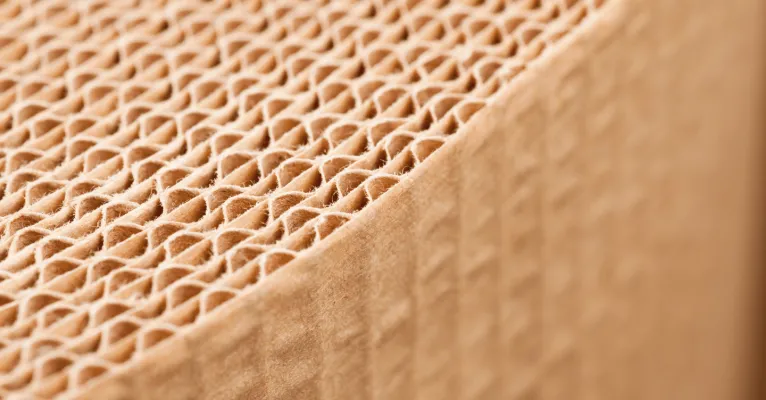
When you buy packaging, you buy performance. Demand the numbers that dictate survival.
We track caliper to ensure the box fits your custom inserts. We measure basis weight to verify the actual mass of the paper. For transit safety, we look at the ECT (Edge Crush Test), which tells us exactly how much stacking weight the box can hold before the walls buckle.
We measure flat crush resistance to see how flutes handle side-impacts. We use the Mullen burst test when internal puncture resistance matters.
Explicit Warning: Do not assume the flute letter alone predicts crush resistance. A poorly glued E-flute made with cheap recycled paper will fail faster than a high-quality F-flute.
When you source suppliers, run through this procurement checklist:
- What is the full board construction?
- What specific liner weights are you using?
- What third-party test data can you provide?
- What specific printing and converting method are you proposing?
🧠 Expert Insight: Always validate your structural specs against ISO 3034 Corrugated Standards to guarantee consistent box performance.
6) The Quick Buyer Decision Matrix
If you need a rapid starting point for your structural engineering, follow this hierarchy:
- Choose E-flute for the best balance of print fidelity, transit protection, and versatile scaling.
- Choose F-flute when a compact, premium shelf appearance leads your marketing strategy.
- Choose N-flute when you need a slim profile and elegant presentation, and your internal product loads are very modest.
The Business Impact: Measure Your Packaging ROI
Secures Premium Appearance Without the Bulk
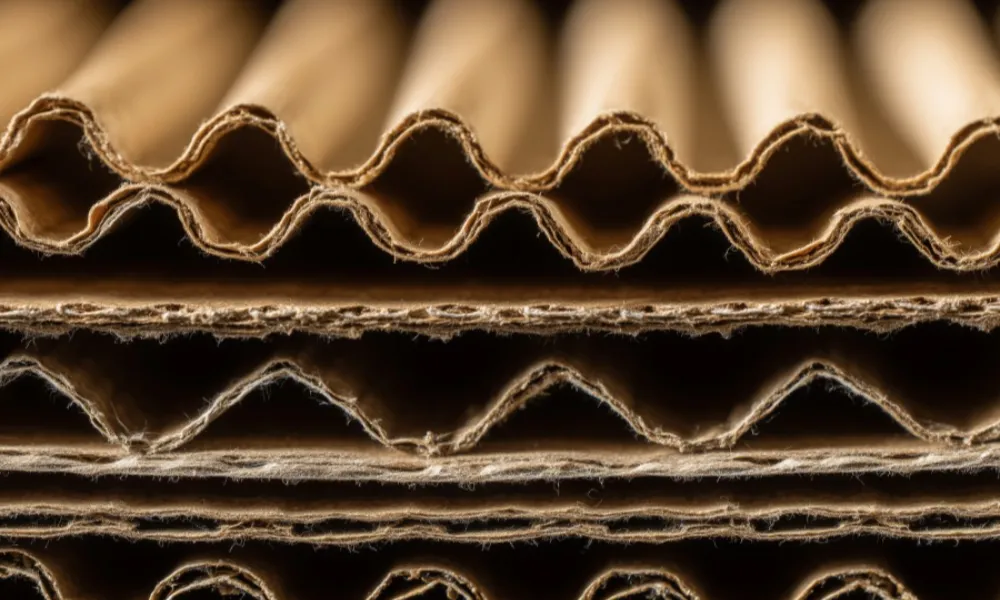
Micro flute packaging provides a dense, flat canvas. It eliminates the visible washboard ridges found on standard corrugated boards. You achieve the tactile feel of a luxury rigid box while dropping the physical weight.
We use this smooth surface to engineer high-definition print packaging that stands out on retail shelves. In our production runs, brands retain maximum visual impact while cutting per-unit material costs.
Maximizes Protection and Minimizes Void Space
The tightly compressed arch structure absorbs impact shock. You eliminate wasted air and bulky padding layers. When paired with custom structural inserts, micro flute forms protective lightweight shipping boxes that lock fragile items securely in place.
You stop paying couriers to ship empty space. We measured a 20% reduction in dimensional volume for a client by swapping standard boards for a precise micro flute profile.
Case Study: The Beauty Brand Pivot
- Challenge: A luxury cosmetics founder paid massive freight fees due to oversized rigid boxes.
- Packaging Change: We engineered a custom E-flute mailer with a premium printed interior.
- Operational Result: The brand cut storage volume by 40% and reduced outbound shipping costs.
- Branding Result: The sleek structural design secured the unboxing experience and drove social media shares.
Drives Sustainable Retail Strategy
This material relies on a renewable, fiber-based structure. It easily replaces unrecyclable plastic blister packs. Your buyers drop the entire box directly into their curbside recycling bin. Opting for sustainable retail packaging builds verified brand trust.
According to McKinsey & Company, over 70% of consumers factor green packaging into their purchasing decisions. Note that your true eco-rating depends on your chosen inks and adhesives. We detail this reality in the next section.
Slashes Total Landed Costs
The ultra-thin caliper allows these boxes to ship and store flat. You fit thousands of extra units onto a single warehouse pallet. This compact footprint slashes your inbound freight bills and frees up warehouse space.
You elevate the unboxing experience without the financial burden of rigid packaging. Transform your shipping economics today with the structural engineering team at LeelinePackage.
📈 ROI Check: Audit your dimensional weight (DIM) charges. Switching from a thick B-flute to a slim E-flute drops your package into a cheaper courier tier, compounding savings instantly.
Custom micro flute packaging looks incredible, but it is not the right fit for every SKU, shipping lane, or finish. Poor specification guarantees structural failure.
Challenge 1: Strength Assumptions Can Mislead You

Buyers frequently misunderstand smaller flute profiles. They either assume thin boards are inherently weak or trust them to hold anything. Both assumptions carry significant risk. We base crush resistance packaging decisions on board construction and physical test data.
For example, packing a heavy glass jar inside a low-density E-flute box will collapse the walls. In our lab tests, a standard E-flute mailer buckled under just 15 pounds of top pressure. We fixed this by upgrading the linerboard weight, not the flute size.
Challenge 2: Moisture, Warping, and Delamination Risk
High humidity severely compromises corrugated board. This risk peaks when designing litho-laminated microflute structures. During humid sea freight, paper layers absorb moisture and swell at different rates. We experienced this during a 30-day transit to Florida.
The humidity warped a batch of F-flute mailers, causing the printed top layer to delaminate from the core.
🛡️ Mitigation: Verify your manufacturer’s adhesive system and moisture control standards before authorizing production.
Challenge 3: Sustainability is Nuanced, Not Automatic
Brands often assume paper automatically equals a green choice. While raw fiber structures recycle easily, finished packaging rarely stays raw. You lose core recyclability the second you add plastic laminations, heavy UV coatings, or mixed-material inserts.
If your brand requires strict sustainability, compare raw micro flute directly against uncoated eco-friendly folding cartons.
⚖️ The Trade-off: Matte film lamination offers premium scratch resistance, but you sacrifice curbside recyclability.
Challenge 4: Testing and Compliance Still Matter
You must qualify your structural design before mass scaling. We require our teams to define specific variables upfront:
- Compression and stacking limits
- Drop test environments
- Export humidity exposure
- Insert assembly methods
Never trust a factory’s verbal promise. We validate all performance claims using established standards. We use ISO 3034 to measure exact board thickness and rely on ISTA transit testing guidance to simulate courier network abuse.
Commercial Friction Points
Scaling custom packaging introduces specific logistical realities. Expect rigid minimum order quantities (MOQs) and upfront tooling costs for custom cutting dies. Physical ink will also show slight color variation from your digital screen.
Finally, factor in extended lead times for physical prototypes. Always order and test a blank physical sample before you scale production.
The Final Verdict on Micro Flute Packaging
Ultimately, micro flute represents the most effective bridge between luxury retail presentation and rugged transit survival. We view it as a diverse family of fine-flute corrugated options, not a single universal specification.
While extreme humidity and heavy product loads can compromise these ultra-thin boards, the massive dimensional weight savings justify the structural shift. You must validate the actual board construction and testing data. Do not rely on a simple flute letter to guarantee safety.
The winning packaging strategy always requires balancing print quality, caliper, physical protection, and shipping logistics.
Our Final Take: Choose a micro flute when you demand premium branding paired with structural efficiency. Stay cautious and look elsewhere if you ship heavy industrial loads, face extreme moisture, or lack defined performance requirements.
Based on our factory data, this format dominates specific markets. We highly recommend it for cosmetics kits, promotional sets, electronics presentation packs, and D2C mailers where the unboxing experience drives customer loyalty.
As global freight costs continue to climb, dimensional weight reduction will force massive market adoption of these compact structures over the next 12 months.
Stop guessing and start testing. We advise you to request a physical prototype. Compare E, F, and N options using real product samples, and review the crush test data before a full rollout. You can explore our advanced manufacturing capabilities at LeelinePackage.
CTA: For expert board selection, physical prototyping, and custom structural advice, reach out to our team.
Related Resources: